More than most people expect, and more the longer you sit there. A single window, watched properly for ten or fifteen minutes, shows you feeding order, pair behaviour, and the small disputes and courtesies that never make it into a field guide. You don’t need a garden, a hide, or a pair of boots for this. You need a chair that already exists, a pane of glass, and the discipline to stay a few minutes past the point where you’d normally get up and put the kettle on.
What a window actually gives you
A window is a fixed point, and a fixed point is exactly what slow watching needs. Birds coming to a feeder or a patch of open ground settle into a rhythm within days: who arrives first, who waits in the hedge until the coast looks clear, who never quite trusts the place even after weeks of using it. None of that shows up in a glance. It only appears to someone who has sat still long enough that the birds stop registering them as a threat, which from behind glass takes far less time than it does standing outdoors in the open.
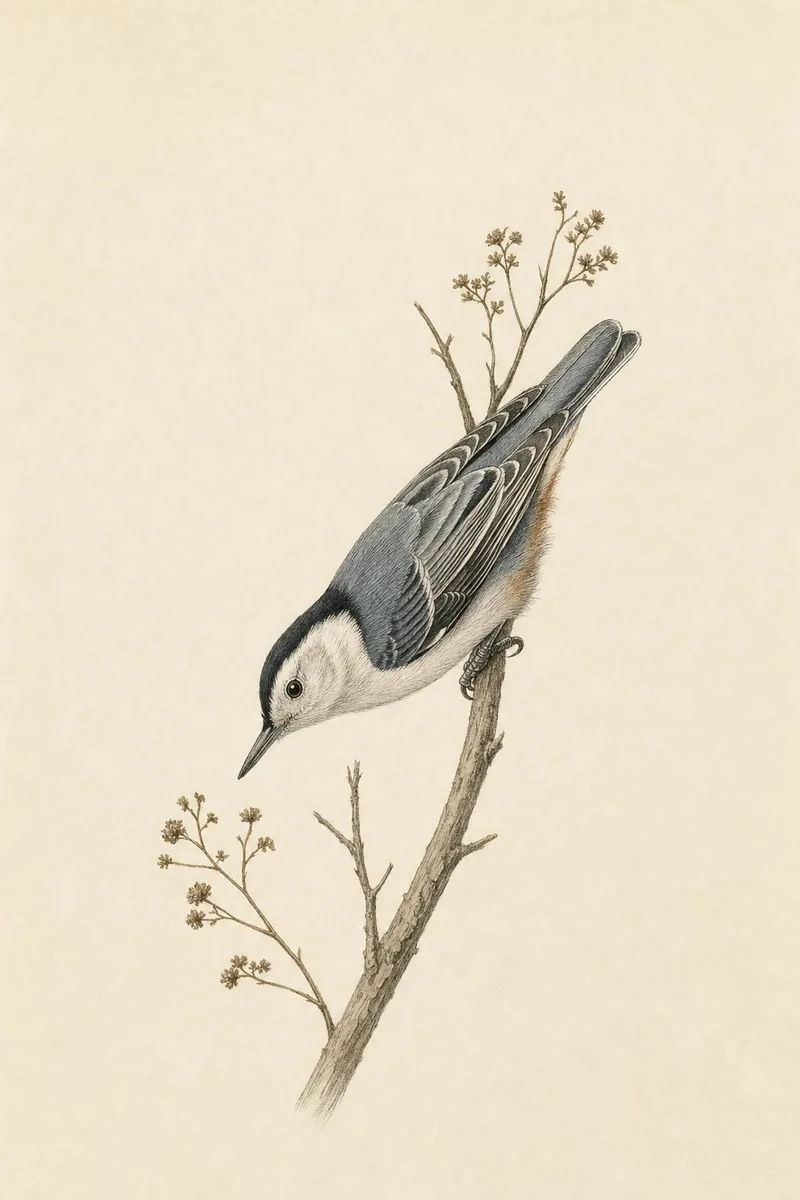
Take a nuthatch working a trunk, which is worth watching for exactly this reason. Most birds work a branch top to bottom; a nuthatch does the opposite, descending head-first as though the usual rules of balance don’t apply to it, pausing at intervals to probe bark a woodpecker already checked an hour before. None of that registers on a first glance. It only shows up once you’ve decided, deliberately, to keep watching the same bird instead of letting your eye jump to the next thing that moves.
A window also removes the reasons outdoor birdwatching usually stalls before it starts: the weather, the midges, the twenty minutes it takes to get dressed for a cold morning. The coffee is already there. The chair is already the right height. All that’s missing is the habit of pointing your attention at the glass instead of the phone in your hand for the length of one cup.
The one-bird method
The most common mistake at a window is trying to watch everything at once, which in practice means watching nothing closely. Pick one bird, whichever has just arrived or is already there, and follow only that one for the next few minutes. Where does it feed. How long between bites. Does it eat on the branch or carry the seed off somewhere first. What changes about its behaviour the moment a second bird lands nearby.
This is slow birding in miniature: not more birds, but more attention paid to one. Wild Bird Post runs on the same idea at a larger scale, a single bird a month rather than a list to tick through, and a window is the cheapest possible way to find out whether that kind of watching actually suits you before committing to anything longer.
Making the window work harder
A few small adjustments earn back a disproportionate amount. Place the feeder or the seed close enough to the glass that you don’t need binoculars, but not so close that a startled bird can build up speed before it meets the pane; the awkward middle distance is worse than either extreme, since that’s where a bird is moving fast enough to hurt itself and still thinks the glass is open sky. Keep a branch or a shrub within one quick flight of wherever birds land, so there’s cover to duck into the moment a shadow crosses the garden. And clean the glass occasionally. It sounds trivial until you’ve tried to watch feather detail through a season of rain spots and pollen film.
Light matters more than most people account for. A window that faces the birds’ background light, rather than looking into it, saves you from watching everything as a silhouette by mid-morning. If your usual chair faces the wrong way for most of the day, it’s worth testing a different seat for a week before deciding the window itself is the problem.
Time of day changes what you’ll see almost as much as placement does. The first hour after sunrise tends to be the busiest at most feeders, since birds are replacing whatever energy they burned overnight, and a slow ten minutes then will usually outperform an hour spent watching at midday. If mornings don’t suit your schedule, dusk is the other reliable window, though by then the light for actually seeing feather detail is working against you.
What a window can’t do
It’s worth being honest about the limits, because pretending otherwise doesn’t help anyone stick with this. Glass takes the sound out of the picture, and birdsong carries information a window will never give you: which bird is where before you can see it, and often what it’s doing. A window is also one-sided; you get whichever angle your house happens to face, and no amount of patience changes that. Anyone who finds they want the soundscape and the wider view as well, not instead, will eventually want to take the same unhurried attention outdoors, and that’s a genuine next step rather than a failure of the window method.
Worth writing down, even briefly
A one-line note after each sit turns a habit into a record: date, weather, who showed up, one thing they did that you hadn’t noticed before. It doesn’t need to be more than that. Read back over a few weeks of lines like these and a pattern usually surfaces on its own, the kind you’d never have caught in the moment itself. An earlier piece on this site goes further into building that into an actual morning routine, chair and feeder and all, if ten minutes at the window turns into something you want daily rather than occasional.
That’s the whole method: one window, one bird at a time, and the patience to stay in the chair a little longer than feels strictly necessary. Subscriptions are open: $24 monthly, $135 prepaid for six months or $240 prepaid for twelve months, with postage included to the US, Canada and Europe. Read Letter No. 0 free on the site before choosing. Prepaid gifts do not renew and include an optional note at checkout.