The world behind the letters
Wild Bird Post is a story told in twelve letters, and this page is the ground it stands on. Josiah Rook is invented. The America he writes from is not. Here is what a working field collector in 1832 actually did for a living, why he shot the birds he drew, what it cost to put a letter in the post before postage stamps existed, and how a hand-coloured bird plate was made. Sources are named as they come up and listed in full at the end. If you would rather read the fiction first, Letter No. 0 is on the site free.
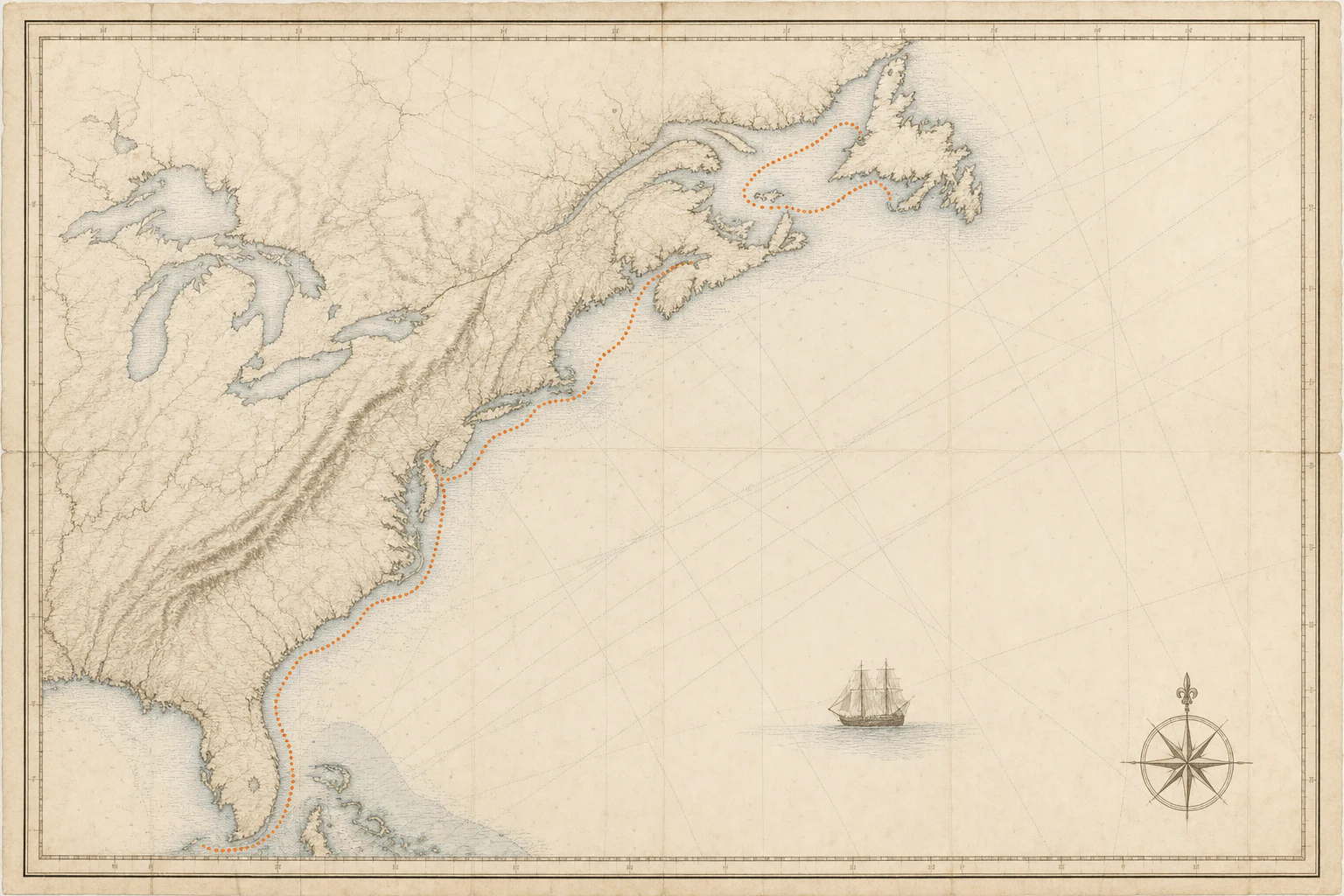
He leaves Bordentown, New Jersey in spring 1832 and is gone twelve months. The road runs south first, down the seaboard to Charleston and on to the Florida coast, then inland to the swamps. In summer he turns north with the season, up the coast to the Bay of Fundy, out to sea, and further north still. He comes home the long way, through the interior, in winter.
Which bird carries which letter is not published in advance. It is sealed until that letter is in the post, and it stays sealed here. What follows is the road, not the roll call.
I March
II April
III May
IV June
V July
VI August
VII September
VIII October
IX November
X December
XI January
XII February
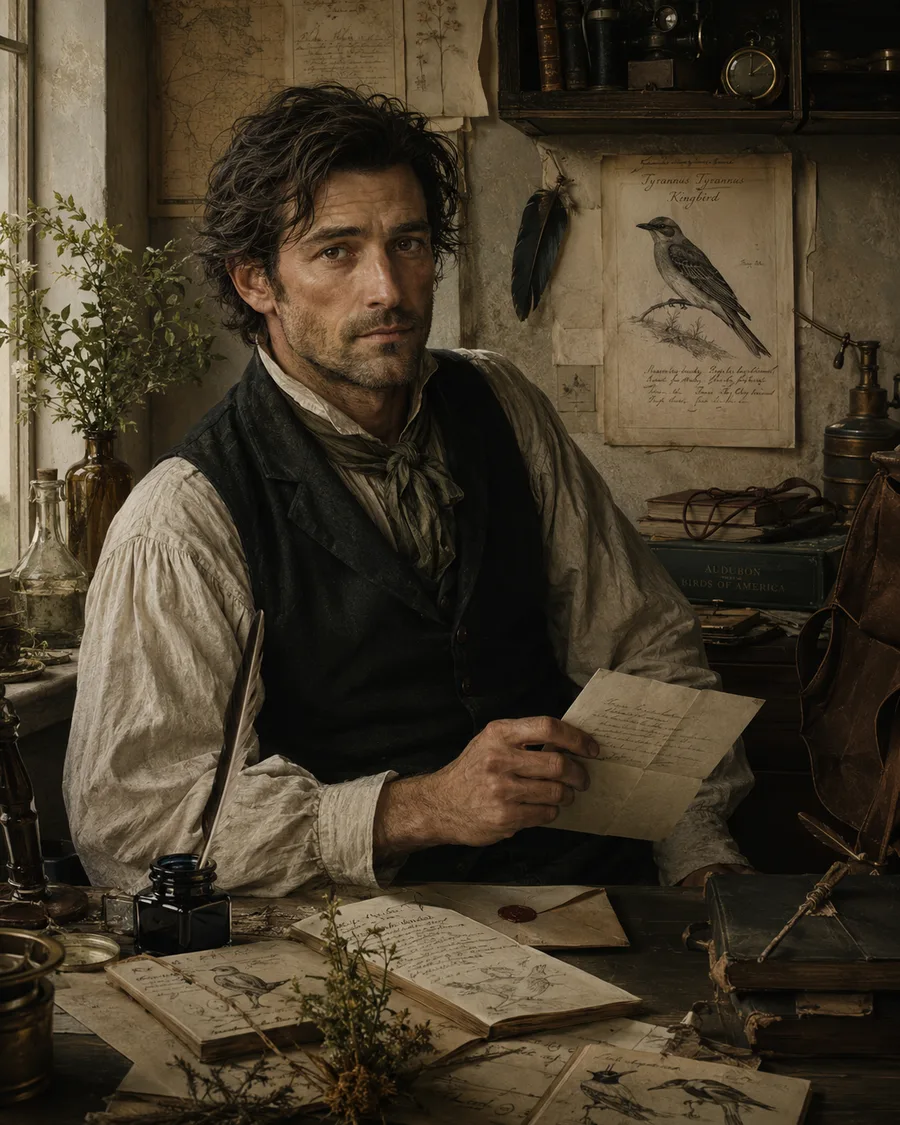
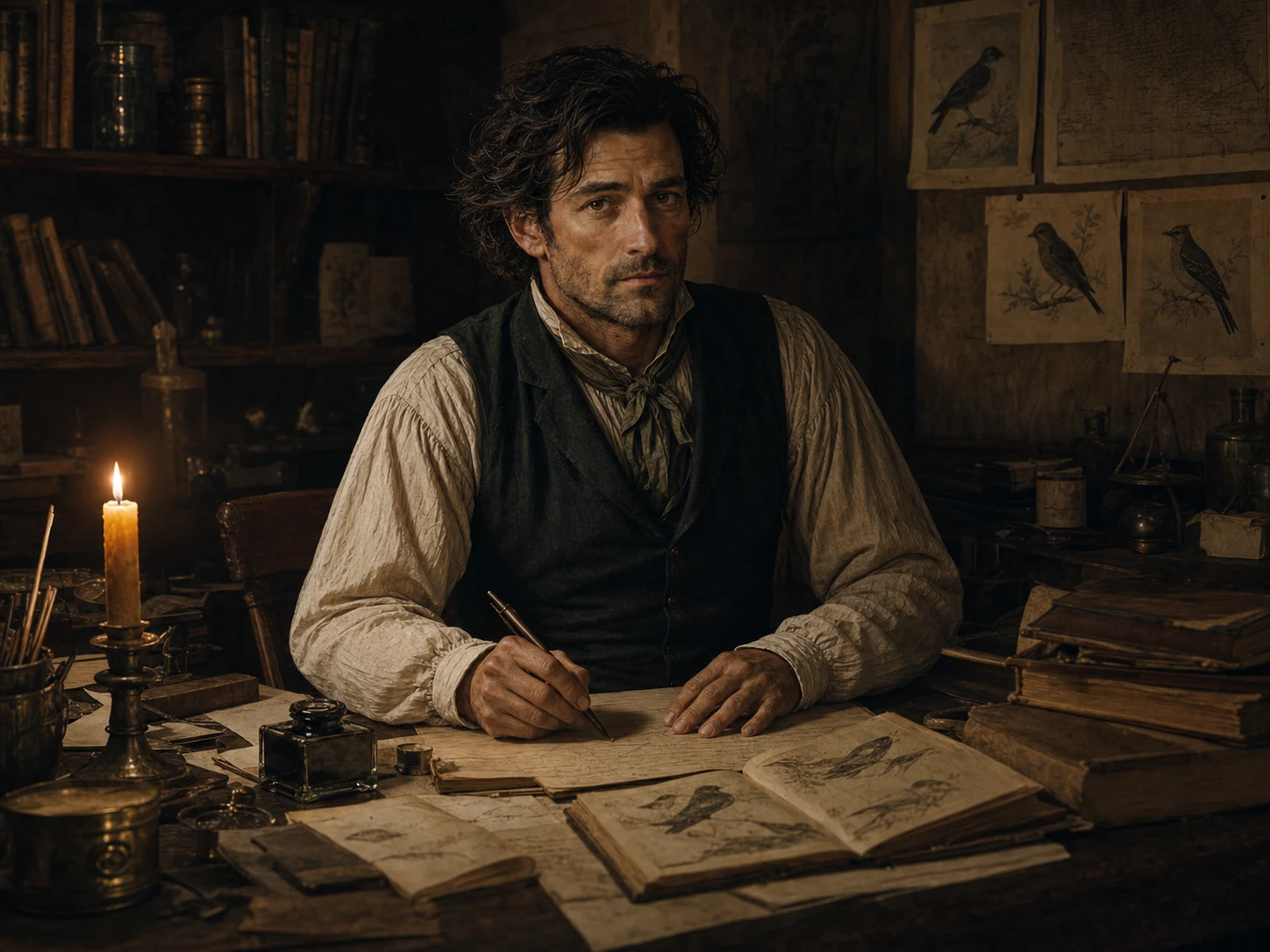
He is 38, born in Bristol, Pennsylvania to a boat carpenter, apprenticed at fourteen to a Philadelphia engraver and stationer. That apprenticeship is the reason he understands what a plate costs: he learned copperplate line work, ink, paper and how a drawing has to be reversed before it can be printed, all before he learned to make a living from birds.
His trade is field collector. He shoots, skins and prepares specimens, makes field sketches while the colour is still in the plumage, and sells the lot on to better-connected men whose names go under the plates instead of his. That is the whole reason history never heard of him. He is not a lost genius. He is a working supplier who sold his labour by the crate, and there were hundreds like him.
He is always a season behind the famous men, and he knows it. The year in these letters is his attempt to stop being behind them. More about the naturalist is on its own page.
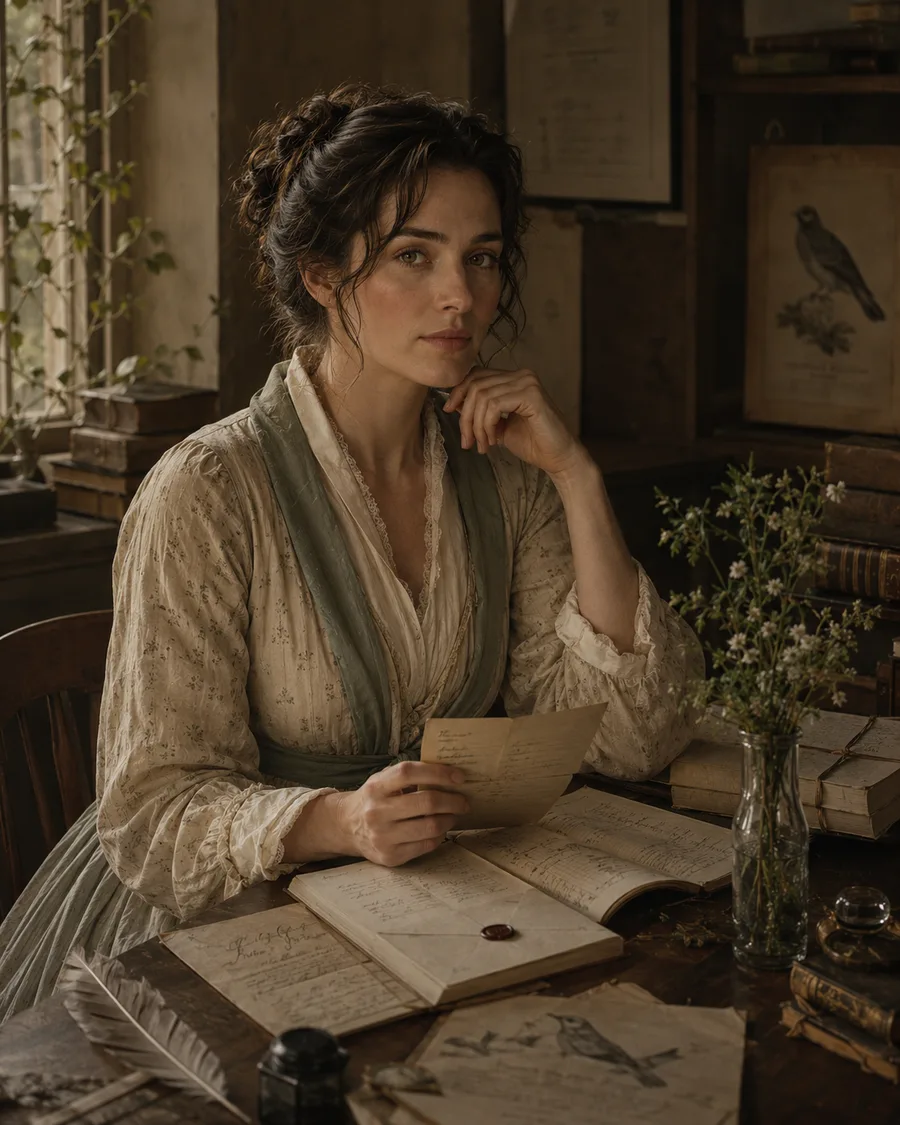
Clara Helena Vandegrift is 30, of Willowbank on Farnsworth Avenue in Bordentown, New Jersey. She is the woman Josiah is courting, and she is not his wife. Her father refused him permission and set a condition instead. What that condition is stays off this site on purpose: it is the arithmetic the twelve letters are built on, and stating it here would spend it before the first envelope opens.
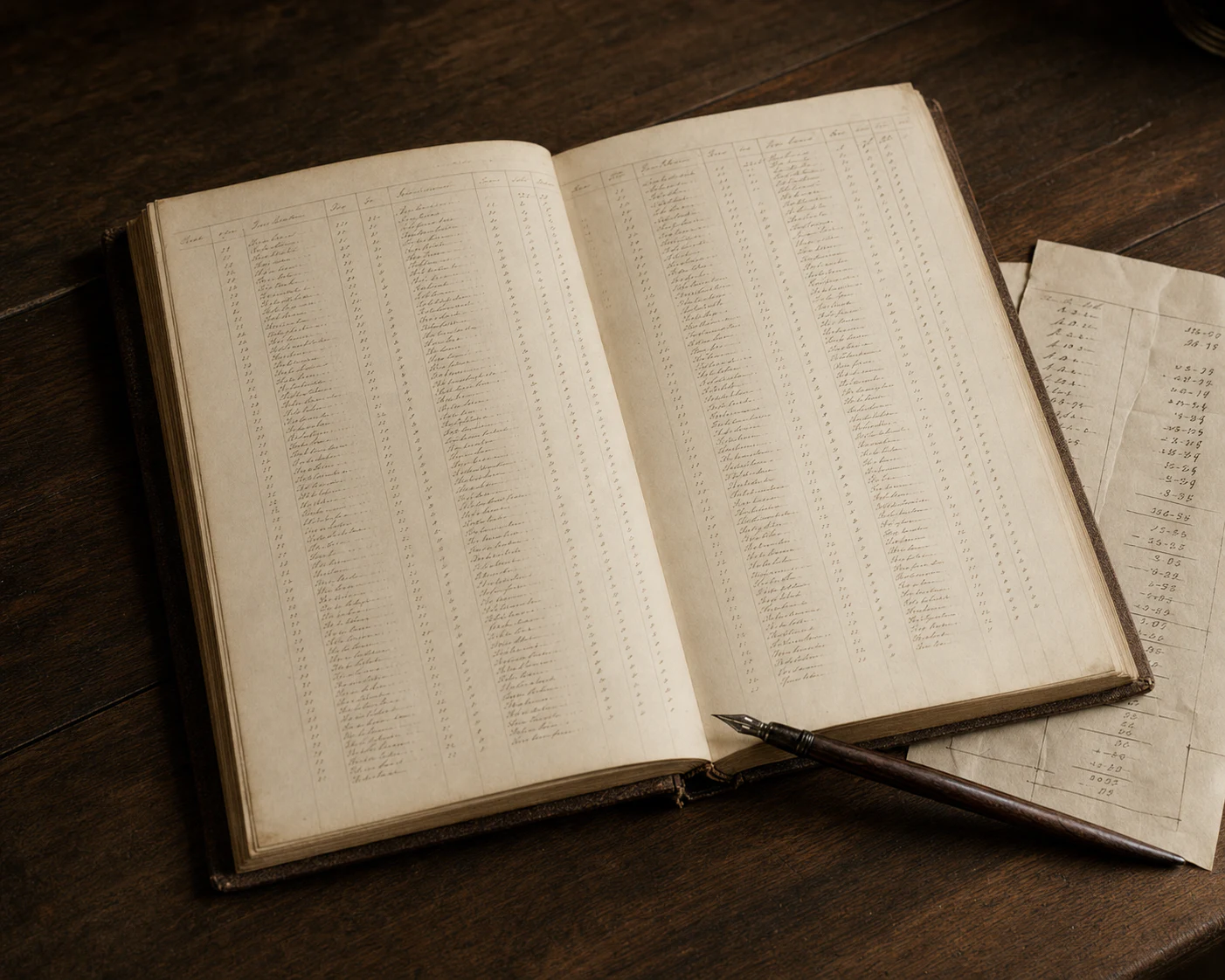
She is not the woman at the window. She runs the home office of the publication he is trying to bring out: the subscriber ledger, the instalments, the letters to printers, the paper samples, the engraving estimates, the running list of plates promised against plates finished. She does not write poetry. She underlines figures.
Her own letters are never reproduced. You read only what Josiah answers, which is how you come to know her: by the questions he is clearly replying to. The letters are addressed to Clara, not to you. A subscriber is reading someone else’s correspondence, and the whole thing only works because that is true.
Josiah Rook is fiction. The world is not.
Invented: Josiah, Clara, her father Cornelis, and Willowbank. Farnsworth Avenue is a real Bordentown street; the house on it is made up, deliberately, so that no real address is printed at volume on thousands of envelopes. The portraits on this page are painted rather than photographed, because photography as the public would come to know it did not exist yet in 1832.
Real: the birds, the places, the seasons, the weather, the shipping, the working practices, the printing trade, and every figure quoted below. The naturalists named are real people and their books are real books. Where a source could not be checked, the claim was cut rather than smoothed over, which is why some obvious things are missing from this page.
We say this on the story page too, and inside the letters themselves, because a reader should never have to work out which half is true. If the category is new to you, we have written a plain guide to how historical fiction letter subscriptions work , including where they differ from replica document services.
A natural history book in this period was not written and then sold. It was sold and then written. The author found subscribers who paid in instalments, and their money bought the copper, the paper, the printing and the colouring of the next part. The subscriber list was the business. Losing names was how a book died.
Wilson is the man Josiah has copied pages from, and he came before John James Audubon by a generation. He lived from 1766 to 1813, trained as a weaver in Scotland, and emigrated in 1794. His American Ornithology appeared in nine volumes between 1808 and 1814, illustrating 268 species, 26 of which had not been described before. A set cost 120 dollars.
He raised that money on foot. He travelled from Princeton to Savannah calling at every town of any size with a sample volume under his arm and knocked on the doors of houses wealthy enough to subscribe, covering more than 12,000 miles by foot and boat in the process. He died on 23 August 1813, aged 47, of dysentery and exhaustion, with the ninth volume unfinished. His friend George Ord completed it. The stress of keeping the funding going is generally counted among the things that killed him.
The Birds of America was issued between 1827 and 1838 in 87 parts of five plates each, sold by subscription, 435 plates in all. The first ten were engraved by William H. Lizars in Edinburgh and the rest in London. Fewer than 200 complete sets were issued. That is the scale of the enterprise Josiah is trying to imitate on a working man’s credit, and it is why his ambition is a smaller, cheaper book rather than a bigger one.
This part is not a coincidence chosen for the story; it is why Bordentown was chosen. Charles-Lucien Bonaparte, nephew of Napoleon, arrived in the United States in 1823 aged 20 and settled at his uncle Joseph’s New Jersey estate, Point Breeze, at Bordentown. From there he produced American Ornithology; or, The Natural History of Birds Inhabiting the United States, not given by Wilson, four volumes between 1825 and 1833. He left the country in late 1826. His uncle Joseph held Point Breeze for sixteen years from 1816, with an extensive art collection and one of the larger private libraries in the country, and by the spring Josiah sets out he had gone back to Europe.
So a small New Jersey river town had been, within living memory, a place where serious ornithology was done and where European visitors came to see it. Clara grew up on the edge of that world, admitted to the room but not to the conversation. Josiah was admitted to neither. There is more on what a naturalist’s working life looked like in 1830s America, including what the work paid.
They shot them. There is no gentler way to put it and no reason to try. A bird in a tree holds still for nobody, photography was not available, and a description could not be checked by anyone who had not also seen the bird. To describe a species accurately, to measure it, to draw it at life size and to prove to a sceptical society that it existed at all, you had to have it in your hand.
What a collector produced was not a stuffed bird on a branch. It was a study skin: the body removed, the skin filled, the bird laid on its back with the wings folded into a standard posture so that hundreds of them could lie flat in a cabinet drawer, protected from insects and from light. Each one travelled with a label saying where it was taken and when. A skin without its label is close to worthless, which is why the field-note card is the part of a Wild Bird Post envelope that is most faithful to the real thing.
The limiting factor was not marksmanship. It was insects. The French naturalist René-Antoine Ferchault de Réaumur was already complaining in the 1740s that specimens were being eaten faster than they could be gathered. The answer was arsenical soap, worked out by Jean-Baptiste Bécoeur, a French pharmacist who lived from 1718 to 1777 and kept the recipe to himself in the hope of selling it. It was published after his death, appearing in print in 1800 in a treatise on ornithology, and promoted into general use by Louis Dufresne, a taxidermist at the Paris museum. It remained the standard preparation for roughly a hundred and forty years.
This is the detail that makes a field collector’s life legible. His hands are scarred, he is handling arsenic most days, his boxes have to stay dry, and a wet fortnight can destroy a season’s income. When Josiah writes about the weather, he is not being poetic about it.
Josiah does not begin the year troubled by any of this. Collecting was ordinary scientific practice and it was how he ate. Whether that holds for twelve months is one of the things the letters are about.
There were no postage stamps in the United States until the 1840s, and for most letters there was no envelope either. Postage was charged by the sheet, so an envelope would have been one more sheet and one more charge. A letter was written, folded in on itself, the address written on the blank outer face and the whole thing closed with sealing wax. The post office stamped its mark across the address.
A single letter meant one sheet of paper. Two sheets was a double letter and cost double. Rates went by distance, and under the schedule in force through the 1830s a single letter cost 6 cents up to thirty miles, 10 cents up to eighty, 12 and a half cents up to a hundred and fifty, 18 and three quarter cents up to four hundred, and 25 cents beyond that. The fourth of those was set by an act of Congress of 3 March 1825.
And here is the part that changes how you read any letter from this period: the sender usually did not pay. Postage was collected from the person who received it.
A long letter from a long way off arrived as a bill at someone else’s door. A man writing from the Florida coast to New Jersey was spending his sweetheart’s money every time he added a sheet, and she paid it before she could read a word of it. That single fact does more to explain nineteenth-century letter-writing habits than anything else on this page, and it is the reason Josiah’s letters are dense, small-handed and written to the edges. Reform came in 1845, after his year: Congress cut a single letter to 5 cents under three hundred miles and 10 cents beyond, and redefined a single letter by weight instead of by sheets.
By the late 1820s the Post Office Department had put mail on contracted steamboats along the east coast, between New York, Philadelphia and Baltimore and from Washington down to Richmond, and in the early 1830s on the Ohio River. Stagecoaches carried the mail on parts of every route and carried it alone whenever the water froze.
Speed was the standing complaint. In 1835 a letter took, on average, eleven days and fifteen hours to get from New York to Vandalia in Illinois. Postmaster General Amos Kendall launched an Express Mail in 1836 along the New York to New Orleans road, carrying ordinary letters at three times the normal postage and cutting that same run to four days and fifteen hours. It was largely obsolete within two years as the railways spread.
For a correspondence, that lag is the whole shape of the thing. Josiah answers questions Clara asked a month ago, in circumstances she cannot picture, and a reply that does not come may mean anything at all. We have written more on how mail actually moved in the 1830s and on what a letter physically looked like before envelopes were ordinary.
A plate is not a painting. Between the artist’s watercolour and the sheet that reached a subscriber stood an engraver, a printer and a room full of colourists, and each of them could ruin it.
The image was cut and etched into a copper plate in reverse, which is the skill Josiah learned as an apprentice. Line work alone gives you outline and hatching. Aquatint gives you tone: a powdered resin ground is fused to the plate so that acid bites around the grains, producing a wash of shading rather than a mesh of lines. It is how a printed bird gets sky behind it, and weather, and water. It is the reason Robert Havell Jr, who lived from 1793 to 1878, was worth crossing an ocean for.
Havell engraved 425 of the 435 plates of The Birds of America, working at it for eleven years to 1838. His father printed them and had them coloured. The division matters: the celebrated name belongs to the man who painted the birds, while the plates themselves are the work of a London workshop that is barely named on the title page. Josiah has been on the wrong side of that arrangement his whole working life.
There was no colour printing. Every plate was coloured by hand, in watercolour, by workers following a pattern plate, each one often doing a single colour across a whole batch before it moved on. Even at fewer than two hundred sets, 435 plates apiece is tens of thousands of sheets, every one painted by a person. It is slow, and it is where the money goes, and it is why an engraving estimate is the kind of document Clara actually keeps.
Copper is expensive, and a copper plate wears. Lithography works the other way round: the image is drawn on limestone rather than cut into it, the stone can be reground and used again, and the drawing can be made directly rather than in reverse by a specialist. The trade moved. The octavo Birds of America of 1840 to 1844, 500 plates in seven volumes issued in a hundred parts, was printed as hand-coloured lithographs by John T. Bowen of Philadelphia, and it reached far more American households than the folio ever did.
That shift is just after Josiah’s year, and it is exactly the shift his own proposed book is betting on: a beautiful book that ordinary households could afford, rather than a monument for a few hundred libraries. We go further into how bird plates were made and into the longer story of bird illustration on the blog.
These are the pages the sections above are built from, read on 9 August 2026. Nothing is listed here that was not used. Where two sources disagreed on a date, the claim was left out rather than averaged.
Rates for Domestic Letters, 1792 to 1863
United States Postal Service, Office of the Historian
The rate tables themselves, including the distance bands in force through the 1830s and the definition of a single letter as one sheet of paper.
United States Postal Service, Office of the Historian
Which mail routes went to steamboat contract and when, and where stagecoaches still carried the mail.
How to Post a Letter, 19th Century Style
Iowa State University Library, Preservation Department
How a letter was folded, sealed and addressed before envelopes, written from the damage such letters carry today.
When express riders carried the U.S. Mail at a gallop
History on the Fox
The 1836 Express Mail: the route, the surcharge, and the transit times it was set up to beat.
Wilson Ornithological Society
Wilson dates, the weaving trade he came from, and the nine volumes published between 1808 and 1814.
Alexander Wilson: America's First Birdman
Oak Spring Garden Foundation
The subscription price, the species counts, the distance he covered and the circumstances of his death.
Alexander Wilson, the Father of American Ornithology
American Birding Association
How he actually sold the work: door to door, with a sample volume, town by town.
Louisiana State University Libraries, research guide
The folio and octavo editions side by side: dates, plate counts, engravers, and how each was issued to subscribers.
Linda Hall Library of Science, Engineering and Technology
The aquatint work itself, the eleven years it took, and the division of labour between father and son.
British Ornithologists' Union, by Bob Montgomerie
Arsenical soap: who worked it out, who published it, and why bird collections could not grow without it.
Wikipedia, general reference
Used only for the physical description of a study skin and how skins are stored. Listed because it was used, not because it is the best source available.
Linda Hall Library of Science, Engineering and Technology
The ornithologist who lived at Bordentown and continued Wilson, with dates for his arrival and departure.
Point Breeze (Bonaparte Estate)
Encyclopedia of Greater Philadelphia
The Bordentown estate, its library and collections, and the years it was occupied.
A field companion is published here alongside each letter, on the day that letter goes into the post. It covers the bird that letter carries, the place it was written from and the history sitting behind it, at a length a letter has no room for. There will be twelve, one a month, arriving in step with the series.
They appear when the letter is posted and never before, for the same reason the programme is sealed. Naming the bird in advance takes the envelope’s job away from it.
Field Companion No. 1 is live now. Month one is the eastern bluebird, at Bordentown, in the orchard where the whole thing starts: read the eastern bluebird field companion.
One note on scope. This site does not run species profiles, and it would be worse at them than the site next door. For the natural history of a bird, its range, its calls and its behaviour, use the eastern bluebird guide on Ask About Birds, or, since Letter No. 0 carries one and it is not part of the twelve, the northern cardinal guide. What we do here is the history the bird sat inside.
Letter No. 0 is on this site in full: the whole letter in his hand, with its plate and its poem, exactly as it arrives. It is the prologue, written from Bordentown, New Jersey the night before he goes south, and it carries a northern cardinal, which is not one of the twelve. Nothing about it is held back, and there is nothing to buy in order to read it.
Twelve letters, posted the first Tuesday of every month, with postage to the US, Canada and Europe included in the price. Choose a plan to begin the correspondence.
Choose monthly payments or a prepaid run. Read Letter No. 0 on the site before you decide.
