In 1830s America, “naturalist” was not a job with a salary attached to it. There was no national scientific institution paying people to travel and describe wildlife. Working naturalists supported themselves by publishing books through advance subscriptions, selling specimens and skins to private collectors and museums, or attaching themselves to funded expeditions as the person who actually knew how to shoot, skin and identify what the party found. Most of them, even the ones whose names survived, were in some kind of debt for most of their working lives.
No such profession existed yet
The men who did this work came from ordinary trades. Alexander Wilson had been a weaver. Many others were apothecaries, printers, ministers or physicians with a private obsession that outgrew their actual employment. What they had in common was that natural history had to be paid for out of something else, whether that was another job, a patron’s goodwill, or the willingness to sell what they found to someone with money. A specimen only had value once it reached a dealer or a collector’s cabinet, and getting it there, intact, correctly labelled and still recognisably coloured, was itself a skilled trade that the naturalists whose names ended up on the title page rarely did alone.
The subscription model that paid for the books
The books themselves were usually funded before a single copy existed, through subscription publishing: a naturalist would sign up buyers in advance, often delivering the work in instalments of a handful of finished plates every few months, and use those payments to fund the next stage of engraving and printing. It was a common way to finance an illustrated natural history book in this period, and a genuinely precarious one. Subscribers could and did drop out partway through a multi-year project, leaving the author to cover costs already committed. Wilson ran his American Ornithology this way and never lived to see it finished. Audubon, for his own vastly larger Birds of America, raised additional money in Britain by charging admission to see his original paintings on public display, on top of subscription income, because the subscription model alone was not always enough to keep a project like this solvent.
Two working naturalists of exactly this decade
In 1834, the botanist Thomas Nuttall, then in his late forties, and the young naturalist John Kirk Townsend joined Nathaniel Wyeth’s second overland expedition west, travelling by wagon up the Platte River and down the Columbia to the Pacific, becoming among the first scientist-travellers to cross the continent in one continuous trip. Townsend, trained in medicine and taxidermy as well as ornithology, collected dozens of new bird and mammal species along the way, several later named for him. He and Nuttall sent bird skins back east to the Academy of Natural Sciences in Philadelphia and to Audubon himself, who used some of Townsend’s specimens as the models for plates in his own book.
That is what a real, working, moderately well-connected naturalist’s 1834 looked like: unpaid or barely paid field labour, specimens sent to better-funded men who could actually publish them, and a body of discovery that mostly ends up credited to whoever had the press. It was not an unusual arrangement. It was closer to the rule than the exception.
The unglamorous economics of collecting
Shooting a bird was the easy part. Preserving it well enough to survive a journey of weeks or months was the actual skill, and it depended on speed and on chemistry. The specimen had to be skinned and treated, usually with an arsenical soap of the kind popularised earlier in the century by the French naturalist Louis Dufresne, before insects and decay destroyed it. A naturalist who was slow, careless or simply unlucky with weather could lose a season’s work between the shot and the cabinet. None of this paid particularly well even when it went right, which is the quiet reason so many capable naturalists of this era, Wilson included, died with more debt than reputation, however well their names are remembered now.
Josiah Rook is not one of them
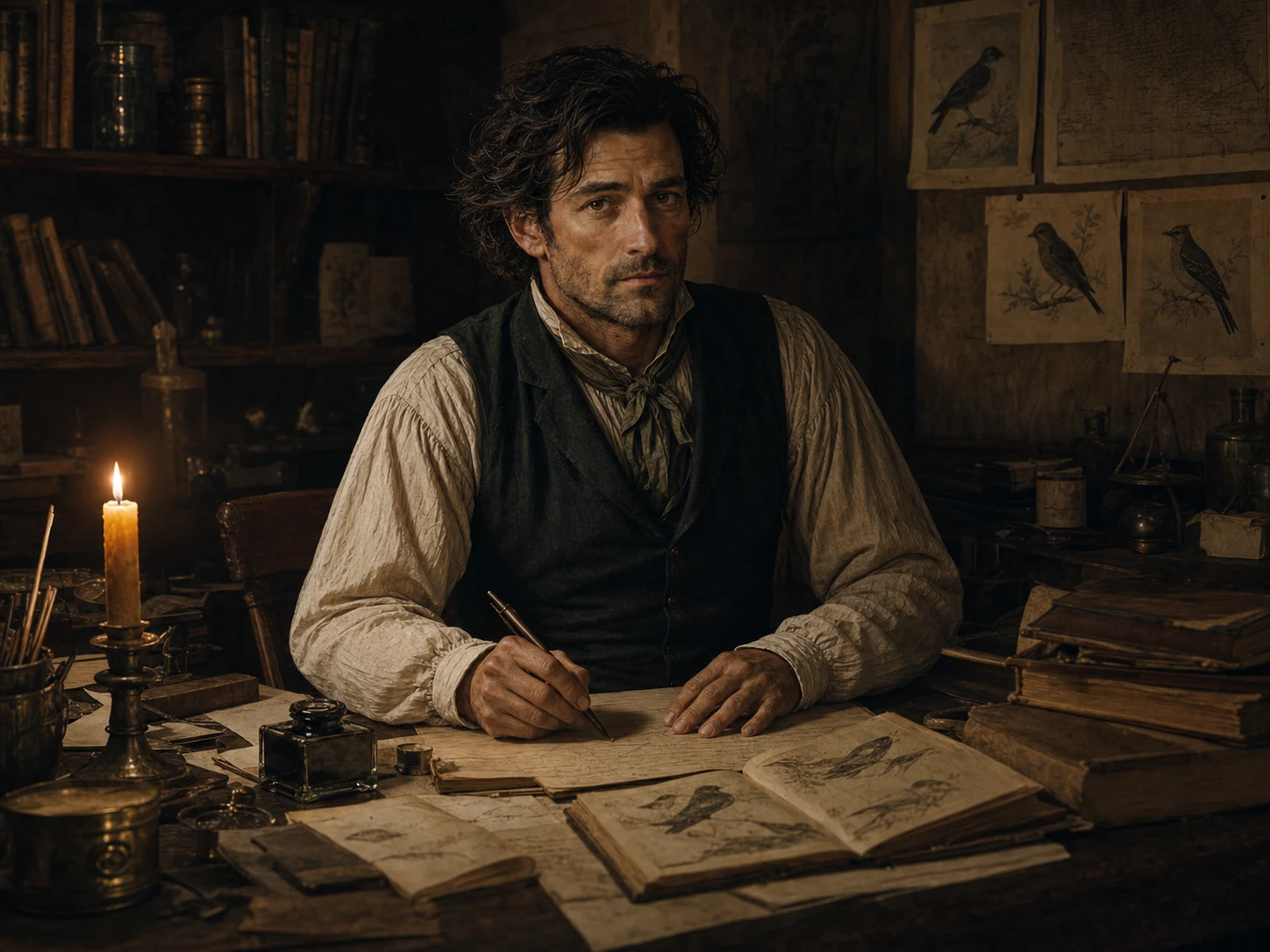
The letters this site publishes are written by Josiah Rook, a field collector who sets out from Bordentown, New Jersey, in the spring of 1832 to build a reputation and a subscriber list of his own, and to earn permission to court the woman he loves. He is invented. He did not exist, did not send skins to Audubon, and appears in no expedition record anywhere. What he is meant to be is the obscure, unrecorded counterpart to Nuttall and Townsend and the dozens like them: a man with real field skill and no name attached to his own discoveries, working under exactly the economic pressure described above, in a decade that genuinely produced people like him even though history kept almost none of their names.
That gap, between the naturalists we remember and the much larger number we do not, is the whole premise of the letters. The fuller account of who Josiah is meant to be sits alongside the real history at From the Road, and the tradition of illustration his fictional book would have depended on is covered in the history of bird illustration.
Most of what actually built American ornithology in this decade was done by people whose names never made it onto a plate. Josiah is a way of remembering that, even though he himself was never one of them.