The bird art subscription
One fine-art bird plate arrives by post every month, printed edge to edge on archival paper and packed flat, never folded.
It does not arrive on its own. It comes inside a letter from Josiah Rook, a field collector working his way across 1830s America, who tells you where he found the bird, what the weather was doing and why he drew it the way he did. Twelve months, twelve plates, one collection that finishes rather than repeating. $24 a month, postage to the US, Canada and Europe included.
Nothing can be bought yet. A complete letter, with its plate and its poem, is free to read right now.
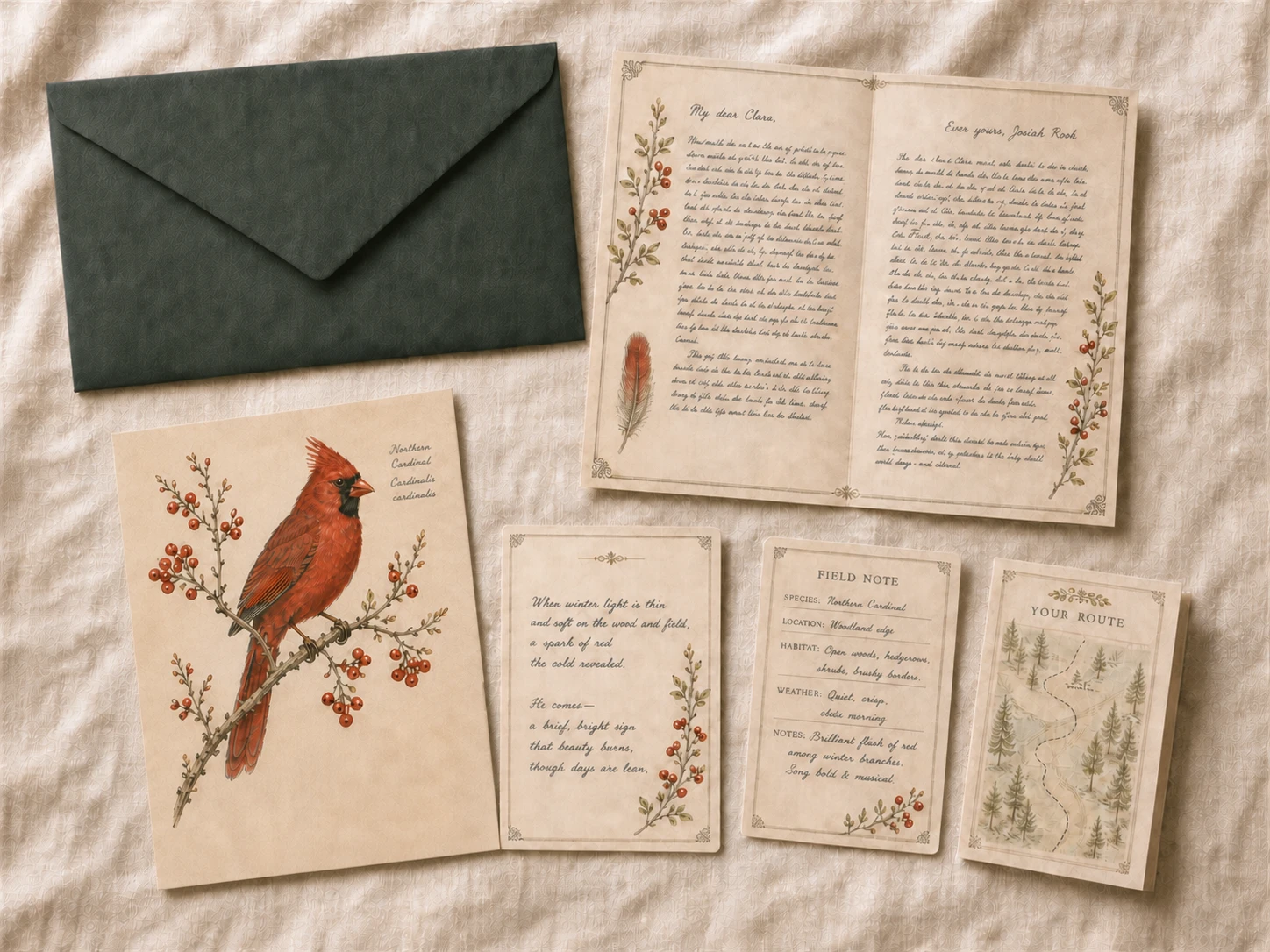
The plate
A bird from that month of the road, in the Audubon tradition, printed edge to edge on archival paper. No border. No mat. Flat in a rigid mailer.
The letter
Two sides in his hand, with sketches down the margins, where he was, what he was short of, and the bird's own story told properly rather than captioned.
The field note
A card that travels with the plate, recording species, location, habitat, weather, date, observer on the reverse. It is what makes the plate feel like a document.
There is a poem card and a rotating paper keepsake as well. See everything in the envelope.
A print bought on its own is a decoration. Twelve arriving in order are a collection, and the difference is not sentimental. They come from one hand, in one palette, on one paper, across one year, composed in the knowledge that they would eventually hang together.
Nothing repeats. The road runs from a New Jersey orchard in early spring, down to the southern coast, north again along the seaboard, out across cold water and home by the following winter. Each plate is the bird of that chapter, and the chapter is wherever he was standing.
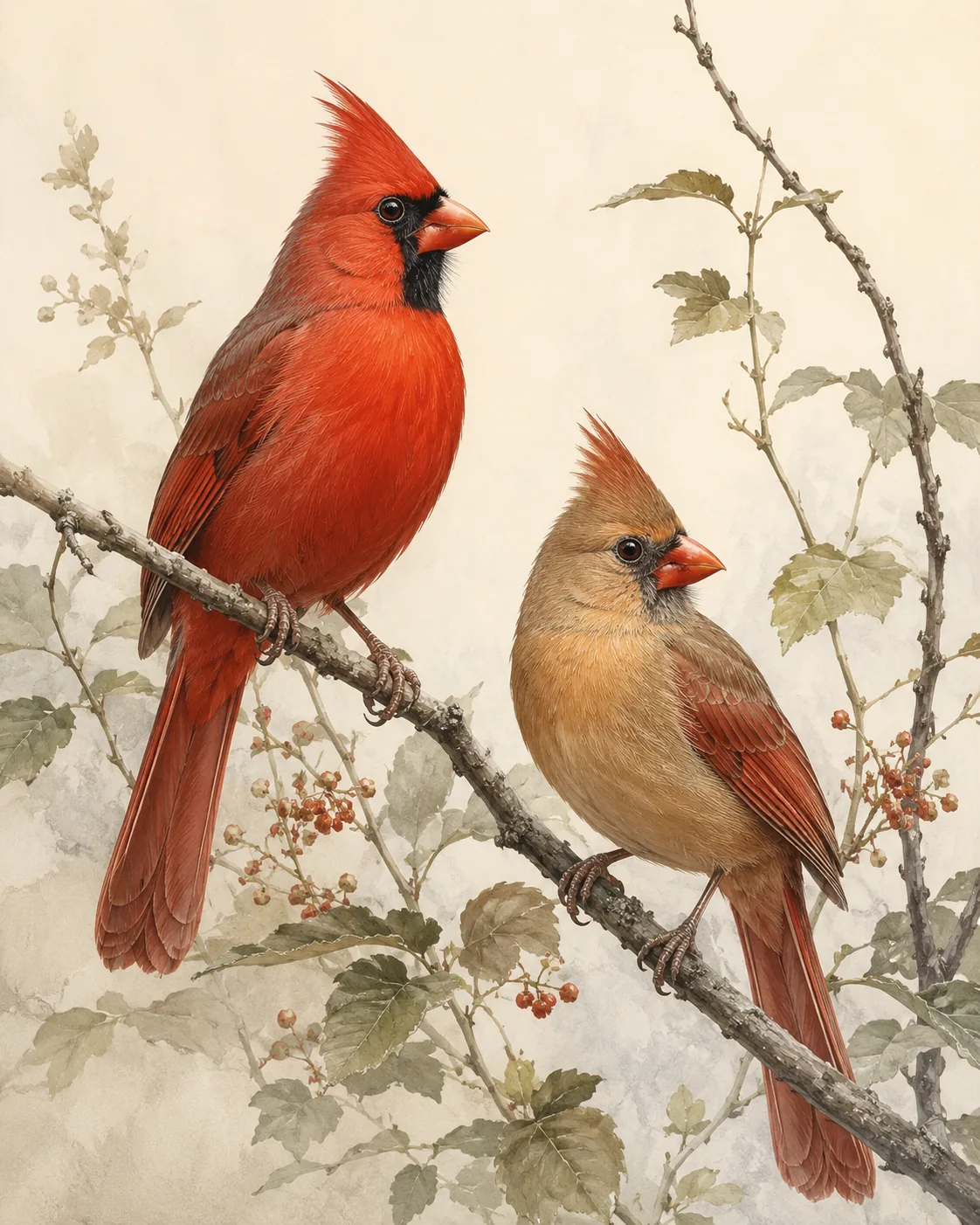
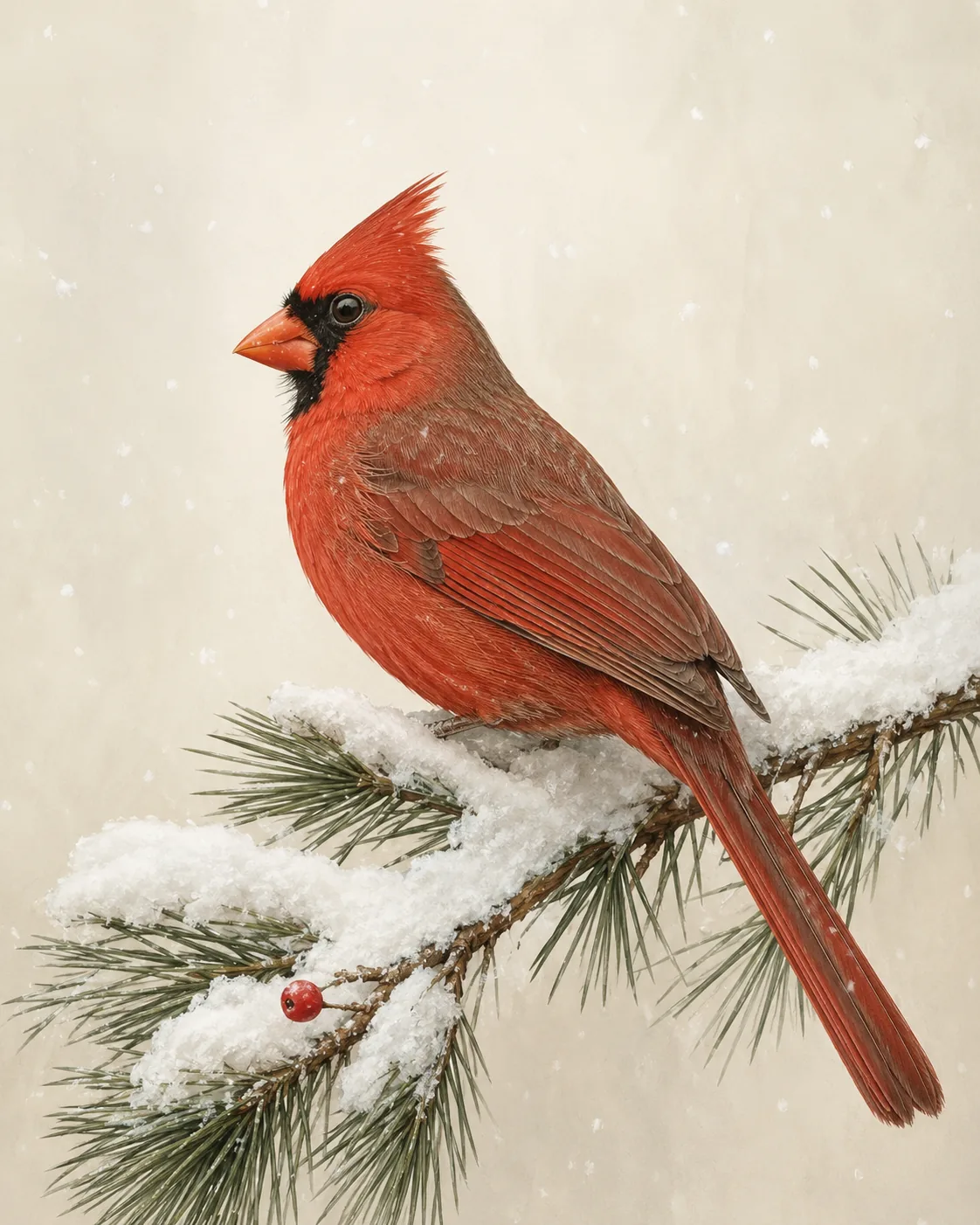
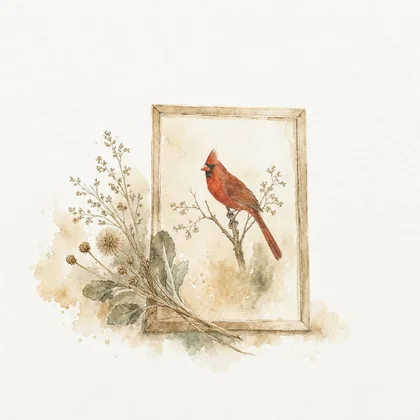
Two birds are named in public. Letter No. 0, the specimen letter we send free, carries a northern cardinal. Month one carries an eastern bluebird. The other eleven stay sealed until their letter is in the post. That is not a marketing device: it is the only way the envelope is still a surprise when it lands on your mat.
I
Eastern Bluebird
IV
Sealed until it posts
VIII
Sealed until it posts
XII
Sealed until it posts
Archival is not a protected word. Anyone may print it on anything, and plenty of people do. But there are real standards underneath it and they measure real things, so it is worth knowing what the word is supposed to buy you.
The Library of Congress points to ANSI/NISO Z39.48-1992 for permanent paper: a pH between 7.5 and 10.0, a minimum two per cent alkaline reserve, under one per cent lignin, and good tear resistance. Internationally the equivalents are ISO 9706, which covers permanence, and ISO 11108, which adds durability for paper meant to be handled as well as kept.
Lignin is the part that matters most to a print. It is the acidic substance that binds wood fibres together, and it is why newsprint yellows and goes brittle in a drawer. Cotton rag paper never had any, because cotton is not wood. Alpha-cellulose paper is wood pulp purified until the lignin is gone. Both can be genuinely archival. A cheap poster stock is neither, whatever the listing says.
Two kinds of colour go through a print head. Dye is a colourant dissolved in liquid: it gives a wide, brilliant range, and it fades and runs. Pigment is solid particles held in suspension, markedly more lightfast and more water resistant, at the cost of a slightly narrower gamut. Conservation guidance on long-lasting inkjet prints is consistent about the pairing: pigment ink, on acid-free, lignin-free stock.
No paper and no ink makes a print immune to light. Conservation research is blunt about it: light damage is cumulative and irreversible, and visible light does it as well as ultraviolet, so glazing that filters UV slows the process rather than stopping it. A plate on a wall that catches afternoon sun will change. Hang it out of direct sun, or rotate the collection now and then, and it will keep.
What arrives here is a fine-art bird plate, printed edge to edge on archival paper.
Measure your plate before buying a frame or mount. Every plate in the series is the same shape, so the twelve hang as a set rather than as twelve odd sizes.
The longer version of all of this
Sources: Library of Congress on permanent paper · American Institute for Conservation, Photographic Materials Group, on long-lasting inkjet prints · Canadian Conservation Institute on light damage
It arrives flat
A folded print is a damaged print. A crease breaks the fibres of the paper and the break does not come out, no matter how long it sits under a book. So every plate travels unfolded in a rigid mailer and arrives the shape it was printed.
It arrives whole
Edge to edge means the painting runs to the edge of the paper. No white margin, no printed border, no mat. That is deliberate. A border is a framing decision, and the framing is yours: a printed border commits you to one look before you have chosen a frame, and it spends paper the bird could have been standing on.
The chapter decides the bird
The bird is chosen for where Josiah is standing that month and what is happening in the letter, not for what would sell fastest. That is the reason the twelve have a shape rather than being twelve nice pictures.
The study is drawn in the Audubon tradition
A full-page composition with the bird doing something, in the plant it was actually found in, rather than posed side-on against an empty ground. That convention is what makes a natural-history plate read as a document.
Colour is judged on paper
A screen emits light and paper reflects it, so the two never agree. The reds move most, which matters more here than it would elsewhere. Nothing is signed off from a monitor.
It is printed edge to edge and packed flat
Then it travels unfolded in a rigid mailer with its field note, which records species, location, habitat, weather, date, observer on the reverse.
How a month's letter gets made How the plates were made in the 1830s
Twelve plates hung together read as one object. Same hand, same paper, same year, a different bird in each. Three across and four down is the usual answer, and it wants a wall you walk past rather than one you sit and stare at: a hall, a stairwell, the run between two doors.
You will not have twelve for a year, which is the awkward part nobody selling a subscription mentions.
What works while the collection is building is a single vertical column. Hang the first three at the height you would hang one picture and add downward as they arrive. A column of three looks finished. A row of three with nine empty spaces beside it looks like a mistake.
The other answer is to hang nothing for a while. Lean them on a shelf or a mantelpiece, overlapping slightly, and move the newest to the front each month. It costs nothing, it survives being rearranged, and it is the only display that gets better while it is still incomplete.
We sell Wild Bird Post, so we have an interest in how this comes out. Ask About Birds, in the next section, is ours as well. We have set out where each one is genuinely the better answer, including the places where it is not this one.
| What you are comparing | A bird art subscription | Buying one print |
|---|---|---|
| What you end up with | Twelve plates made as one set, in order, each with the reason for it written out beside it. | One picture you chose, on the wall this month. |
| Who chooses the bird | We do, chapter by chapter. You find out when the envelope opens. | You do, exactly, from a catalogue you can see before you spend anything. |
| What it costs | $24 a month, with postage to the US, Canada and Europe included in the price. | One payment, once. Nothing to cancel afterwards. |
| When it comes | Posted the first Tuesday of every month, so you know when to look. | As soon as it is printed and posted. |
| What it is really for | The year, and the arriving. The collection filling up is most of the pleasure. | The wall, now. |
| The honest catch | You cannot pick the bird, and it takes twelve months to own twelve plates. | It stays one print. One print is a decoration, not a collection. |
Wild Bird Post is the wrong purchase for a lot of people, and it is worth saying which.
If there is one particular bird you want on the wall, buy it outright. Our sister site Ask About Birds sells individual bird plates in the same tradition, hundreds of them, framed or unframed, and you choose the bird yourself. That beats waiting a year in the hope that we reach your bird, and we are not going to pretend otherwise. Anything you want to know about the species itself, what it eats, where it lives, what it has been taken to mean, lives over there too, and we do not duplicate it here.
Both sites are ours, which is why we can say that without it costing us anything. Weigh it accordingly.
What this one is for is different. A collection built a month at a time, in an order somebody decided on, with the story of each bird written out beside it, is not the same product as a picture you chose and hung. If the second is what you want, the link above is faster.
Post offices are not gentle and paper is paper. If a plate arrives creased, torn or water-marked, tell us and we post another one, free. No photograph, no form, no interrogation. One email is all it takes.
You do not have to send the damaged one back. Keep it or bin it, whichever suits.
Prepaid, fixed length, nothing to remember and nothing that renews on its own. Three months is a taste of it. The full year is the whole story, start to finish, and it is the one we would give.
Six Months
$135
$22.50 a month · one-time
Half the road.
The Full Year
$240
$20 a month · one-time
The whole story, start to finish.
A subscription that posts you original bird art on a schedule instead of selling you one print once. In this one, a fine-art bird plate arrives every month, printed edge to edge on archival paper, inside a letter that explains where the bird was found and why it was drawn that way. Twelve months make one finished collection, and then it ends.
No. The plates are made for the series and are not sold on their own. If you want one particular bird on the wall now, our sister site Ask About Birds sells individual bird plates in the same tradition, framed or unframed, and you choose the bird yourself. That is a better answer than waiting a year hoping we reach your bird.
That the paper and the ink are made not to destroy themselves. For paper, the measurable version is the permanent-paper standard the Library of Congress points to, ANSI/NISO Z39.48-1992: a pH between 7.5 and 10.0, at least a two per cent alkaline reserve, under one per cent lignin, and good tear resistance. ISO 9706 and ISO 11108 are the international equivalents. For ink it means pigment rather than dye, because pigment is solid particles and considerably more lightfast. No print is immune to light, though: the damage is cumulative and irreversible, so keep it off a wall that gets direct sun.
Never. Every plate travels flat in a rigid mailer, unfolded, printed edge to edge with no border and no mat. A crease breaks the paper fibres and the break does not come out, so folding a print is the one piece of damage that cannot be undone.
Two are public. Letter No. 0, the specimen letter we send free, carries a northern cardinal. Month one carries an eastern bluebird. The remaining eleven stay sealed until each letter is in the post, so the envelope is still a surprise when it lands on the mat.
We post another one, free. One email is all it takes: no photograph, no form, and nothing to send back.
A whole letter is on the site, with its plate and its poem, exactly as it arrives. Nothing is hidden behind the checkout.
If the writing is not for you, you will know in a few minutes, and it will have cost you nothing.
Subscriptions are open. Every plan includes:
Choose $24 monthly, $135 for six months or $240 for twelve months. Read the sample letter free before you decide.