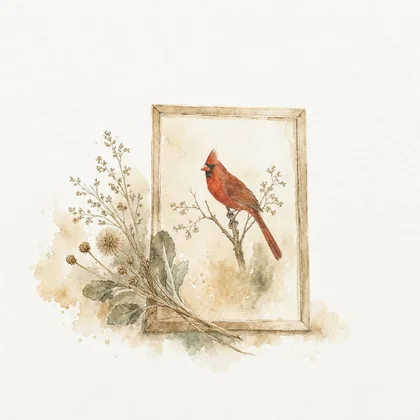
Frame the print you actually have, not a size you assume it must be. In order: measure the print yourself before you look at a single frame, buy or cut a frame to that exact number, decide whether it needs a mount, choose glazing that suits the wall it’s going on, and pick a spot out of direct sun and damp air. That’s the whole job, and it usually goes wrong at the very first step, when people buy the frame before they’ve measured the print.
Measure before you shop for anything
Lay the print flat on a clean, dry surface and measure it yourself, edge to edge, in both directions. A plate printed edge to edge, with no border built into the sheet, means the paper’s own measurement is the same as the image’s: there’s no border to subtract first. Write both numbers down and take them with you rather than trying to remember them in a shop. That measurement is specific to the print in your hand, not to a size category on a shelf, and it’s the only number that actually matters here.
Fit the frame to the print, never the other way round
Once you have the real measurement, there are two honest routes. A framer can cut a frame and a backing board to that exact size, which costs more but fits properly and removes the guesswork. Or you can buy an off-the-shelf frame sized a little larger than the print and bring the opening down to size with a mount, covered below, which is cheaper and easier to find on a shelf. What doesn’t work is buying a frame first and trimming the print to fit it: that’s not reversible, and it’s the one mistake on this list you cannot undo afterwards.
Do you need a mount, and what is it actually doing
A mount, or mat, is the board with a window cut in it that sits between the print and the glass. It does three real jobs: it holds the printed surface off the glazing so condensation and humidity can’t glue the two together over years of hanging, it lets an odd-sized print sit inside a more common, easier-to-find frame, and it gives the eye a resting border before the wall starts. None of that is compulsory. A print mounted straight to its own edge, close-framed with no visible border, is a legitimate look in its own right, and it suits anything printed edge to edge in the first place, since the print was made to be seen whole rather than through a window cut smaller than itself. If you do want a mount, a local framer will cut one to your exact measurement; you don’t need to decide the size in advance.
Glass or acrylic
Ordinary picture glass blocks only around 45% of the UV light that causes fading, which is fine for a hallway that never sees direct sun and not much use for a bright room. Conservation, or “museum,” glazing is held to a different bar: to be sold as UV-protective at all, glazing has to block at least 97% of UV in the damaging range, and the better conservation grades get close to 99%. That upgrade exists in both glass and acrylic. Acrylic is lighter and far more shatter-resistant, which matters above a bed or on a stairwell, but it scratches more easily and holds a static charge that pulls dust to the surface, so it’s the weaker choice for a low-traffic wall nobody’s going to bump anyway. For most rooms, ordinary glass on a print kept out of direct light does the job fine; the UV upgrade earns its price only where the wall genuinely gets sun.
Where not to hang it
Skip anywhere that gets direct sun for part of the day, a wall above a radiator or a working fireplace, and a bathroom or kitchen, where humidity swings hardest and fastest. A hallway, a stairwell, a bedroom wall out of the window’s direct line, or a home office all give a fine-art bird plate a stable, forgiving spot to live for years rather than months.
Hardware that keeps a small frame level and breathing
A small print is light enough that a single picture hook and a sawtooth hanger will usually hold it, but sawtooth hangers are also the reason small frames drift crooked over time, since the frame can rock along the tooth’s curve. A pair of D-rings, one on each side of the frame, spreads the weight and stops that slow tilt far better than a single central hanger. Two small self-adhesive bumpers on the bottom back corners are worth adding too: they hold the frame a hair off the wall, which keeps a flat current of air moving behind the glass instead of trapping still, damp air between the frame and a cold exterior wall.
Leave room for the next one
If the print in your hand is the first of a set that keeps arriving rather than a one-off purchase, hang it with space around it from day one instead of centring it alone on the wall. It’s a small decision now that saves rehanging everything later, and it’s worth making deliberately if you’re on the list for the letters that bring a new plate with them each month. What actually makes a print archival covers the paper and ink side of the same question, if you’d rather know what you’re framing before you decide how.