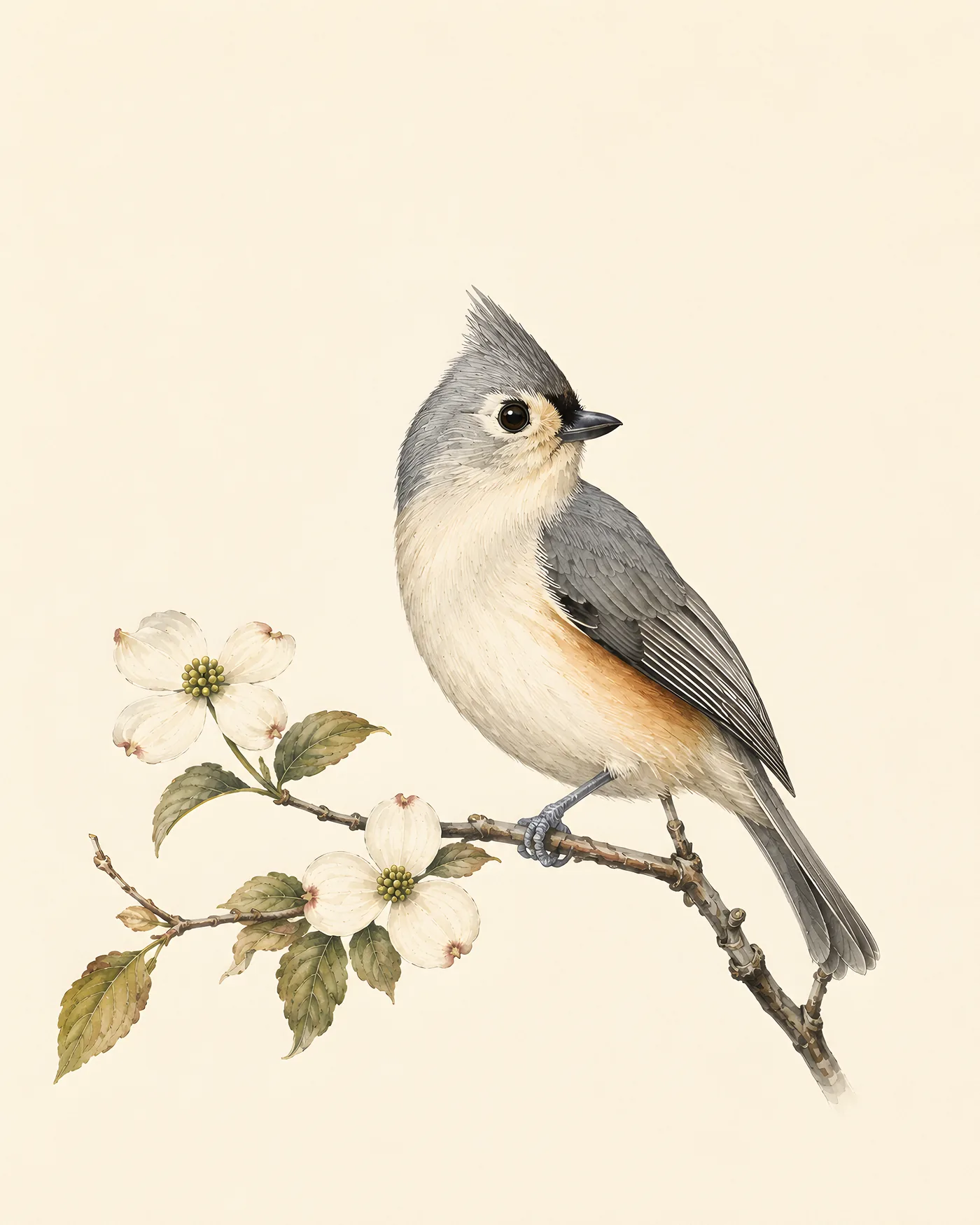
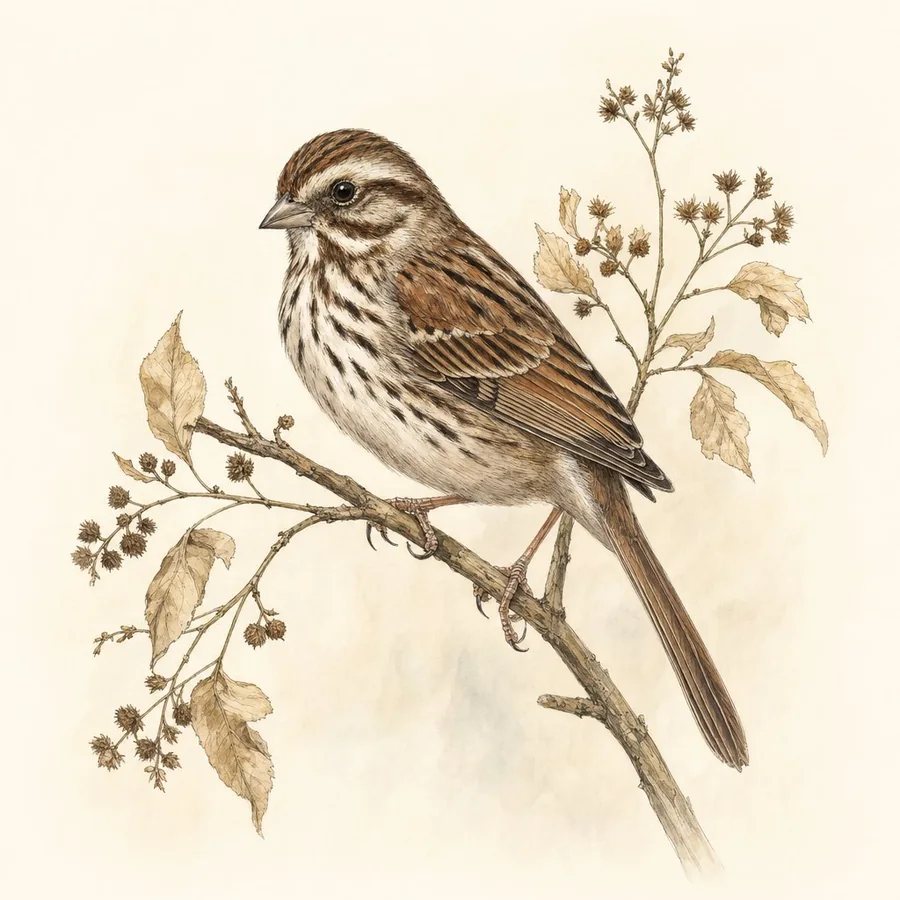
A nineteenth-century bird plate went through four separate trades before it reached anyone’s wall: it was drawn from the bird itself, cut into a copper plate as a line-and-aquatint engraving, printed in a single dark ink, and then painted by hand, one colour at a time, by someone who never touched a pencil. No plate from this period came off a press in colour. Every scrap of blue on a jay or red on a cardinal was put there afterward, by a person with a small brush, working to a pattern.
Drawn before the colour faded
The process started in the field, and it started against the clock. A collector shot the specimen, and from there the naturalist had a matter of hours, not days, before the true colours of the soft parts, the eye, the bill, the feet, began to dull. Alexander Wilson and John James Audubon both worked from birds wired into lifelike poses rather than flat skins, sketching the true colour while it still existed, because no engraving could recover what a fading specimen had already lost. Preserving the skin itself for later reference relied on arsenical soap, a compound popularised in this period by the French naturalist Louis Dufresne, brushed into the hollowed body cavity to keep insects and decay away long enough for the specimen to travel or sit in a cabinet.
Cutting the plate: line, ground and acid
Once the drawing existed, an engraver transferred it to a sheet of copper. The outlines were usually cut as conventional line engraving, but the tonal work, the soft grey of a sky or the depth of shadow under a wing, came from a separate technique called aquatint. A fine layer of powdered resin was dusted evenly across the heated plate, fusing into a grain of tiny dots. Acid was then applied in stages: areas meant to stay pale were painted over with a stopping-out varnish before each new bite, so that the parts left exposed longest to the acid held the most ink and printed darkest. It was a technique of accumulated small decisions rather than a single cut, which is exactly why an aquatint sky reads as soft and an engraved line does not.
This was the technique Robert Havell Jr’s London workshop had mastered by the time it took over the engraving of Audubon’s Birds of America in 1827, after the original Edinburgh engraver lost his own colourists to a strike. The fuller story of how that plate tradition developed, from Wilson’s self-taught line work through to Havell’s aquatint and beyond, is its own piece of this history.
The colourists’ room
Every finished plate started life as a black or sepia print pulled from the copper. Colour was added afterward, by hand, by a workshop of colourists working from a master proof that Audubon himself had annotated with instructions. Accounts of the size of Havell’s team vary, from around fifty colourists to considerably more at busy periods, but they agree on how the work was organised: assembly-line fashion, with each person responsible for a single colour across a stack of prints before passing the sheet on to the next station. One colourist might paint every patch of red across a run of a hundred sheets before the next added the blue, and so on until the bird was complete. It was skilled, repetitive, closely supervised work, checked constantly against the pattern proof, and it is the reason two surviving copies of the same plate can still show slightly different shades: two colourists, working perhaps years apart, from the same design.
Paper built to last
The paper mattered as much as the ink. Audubon’s double elephant folio was printed on heavy stock supplied by the English papermaker J. Whatman, and surviving sheets carry watermarked dates running from 1828 through to 1834, evidence that the same copper plates were being pulled and coloured for years after they were first cut, as new subscribers’ orders came in. All paper of this period was made from cotton and linen rag rather than wood pulp, which would not become the standard until decades later; rag paper cost more and supply was tighter, but it aged far better, which is one reason so many of these plates have survived intact for two centuries. What actually makes an archival print last is its own subject, covered in what makes a print archival.
Why the process still matters
None of this was fast, and none of it was cheap, which is exactly why it is worth knowing before you look at a plate that claims to work in the same tradition. What arrives inside a Wild Bird Post envelope is a modern print, made with modern materials, but it is made with the same respect for the bird as the object: printed edge to edge on archival paper, drawn from real observation rather than invented. If you want the wider cast of naturalists, engravers and collectors who built this tradition in the first place, that history lives at From the Road.
The plate you are holding, in other words, was never meant to be quick. It still isn’t.