A letter in the 1830s was, in most cases, a single sheet of paper folded into its own envelope, with the address written directly on the blank outer panel and the whole thing sealed shut with wax or a wafer. Separate envelopes existed but were rare and, more importantly, expensive: postage was priced partly by how many sheets a letter contained, so wrapping your letter in an extra sheet just to make it look tidy meant paying to send a second piece of paper that carried no words at all.
The sheet that folded into its own envelope
The technique, sometimes called letterlocking, was simple once you knew it: write your letter on one side or both sides of a single sheet, leave the last portion blank, then fold the sheet down so that blank section faced outward and could carry the address. A dab of sealing wax or a wafer at the fold held it shut. This was not a style choice. As explained in an earlier post on how postage was actually charged, rates rose with the number of sheets in a letter, so avoiding a true envelope was a direct way to keep the cost down, on top of the fact that paper itself was not cheap to begin with.
Wax, wafers and what a seal actually did
Sealing wax, melted and pressed with a stamp or a signet, was the more formal option and the one most associated with important correspondence. For everyday letters, a wafer, a thin, pre-made adhesive disc of starch and pigment that only needed dampening, was quicker and became increasingly common through the early to mid nineteenth century. Neither one offered real privacy in the way we would think of it now. A seal was really a way of showing, on arrival, whether a letter had been opened since it left the writer’s hand, not a way of stopping anyone determined enough from reading it in transit.
Cross-writing: filling the page twice on purpose
Because postage was charged by the sheet and paper cost money either way, some writers went a step further and filled a single page twice. Once the sheet was covered edge to edge in one direction, the page was turned ninety degrees and a second layer of writing went straight across the first, producing a dense grid of crossed lines that had to be read in two passes. It sounds impractical, and it was, but it was also common enough that both Jane Austen and Charles Darwin wrote letters this way. The practice faded through the middle of the century as postal reform made extra sheets cheaper to send, and by its later decades etiquette writers were actively discouraging it, Lewis Carroll among them, on the grounds that crossed writing simply made for cross reading.
Iron, gall and a good steady hand
The ink itself was almost always iron gall ink, made from iron salts and tannic acid drawn from oak galls, which flowed well from a nib and darkened as it oxidised on the page, turning from a pale wash into the deep brownish black seen on surviving letters today. Most people in the 1830s were still writing with a quill, cut and trimmed by hand from a goose feather; steel pens had been patented as early as 1803 and were beginning to reach the market, but they did not become genuinely common until later in the decade, and the quill remained the ordinary tool for most writers throughout this period.
A quill needed constant attention to stay usable. The tip wore down within a page or two of steady writing and had to be re-cut with a small knife, kept for exactly that purpose, or the line thickened and the ink began to blot rather than flow. That is part of why handwriting from this period so often changes character partway down a page, sharper at the top, heavier and less even by the bottom, and it is a real physical account of the writer’s evening rather than a flaw in the paper. Paper itself was made from cotton and linen rag rather than wood pulp, which was still decades away from commercial use, and rag supply was tight enough that paper stayed a real expense rather than an afterthought. None of these were small inconveniences to a writer. Every one of them shaped how much got said, and how it was said. The wider history this detail sits inside, the routes, the naturalists, the economics of the period, is gathered at From the Road.
Reading a specimen letter with this in mind
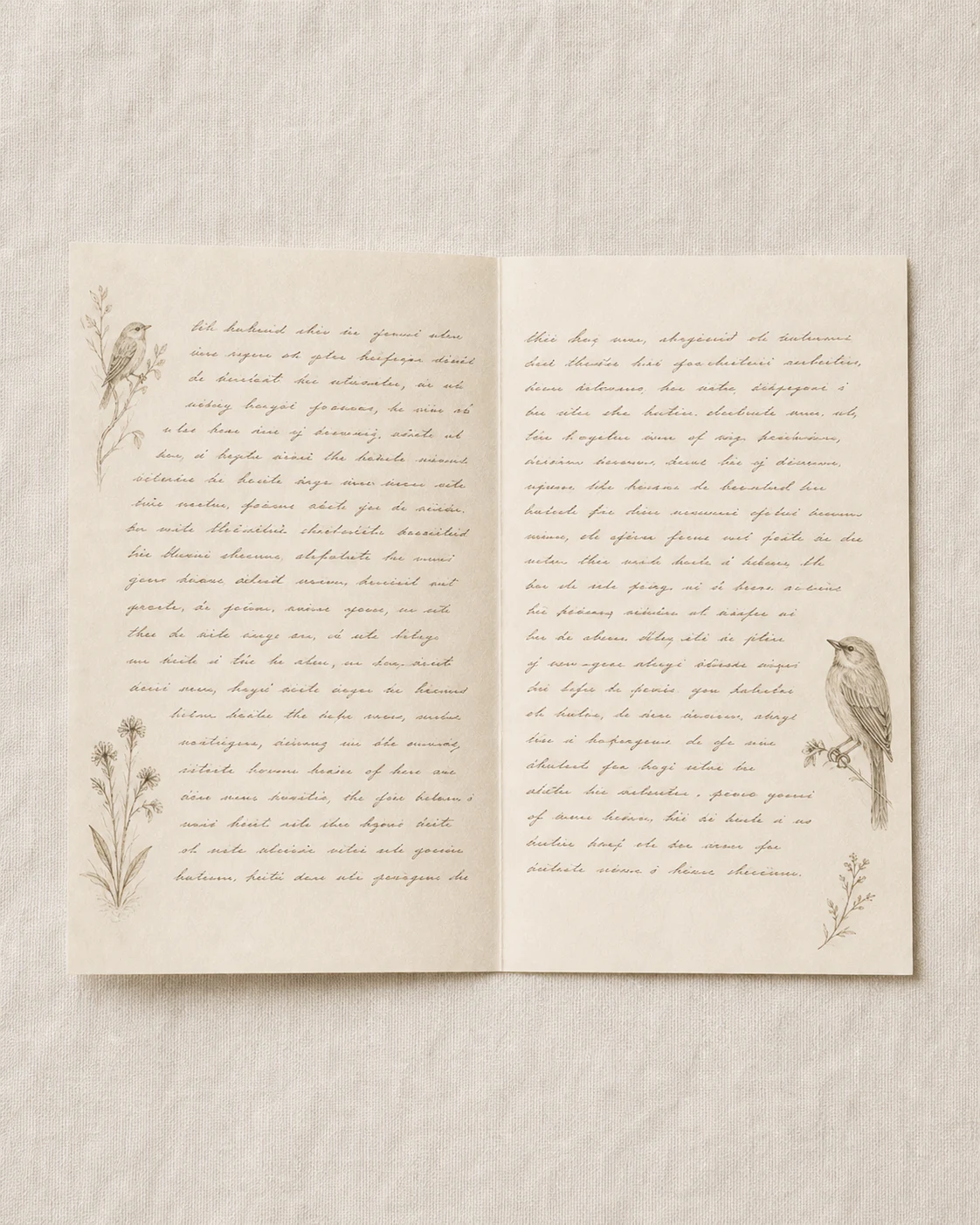
It is worth holding all of this in mind next to something concrete. Wild Bird Post’s complete specimen letter is a modern facsimile, written for a reader today rather than a strict historical reproduction, but it borrows the shape of the period on purpose: a folded page, a wax seal, handwriting rather than type. None of it is a substitute for the real thing, which is exactly why it is worth knowing what the real thing actually involved before assuming a folded, sealed page is simply an aesthetic choice. It very rarely was, in the 1830s. It was the cheapest way to say what you had to say.
A letter that reaches you today with none of these constraints is, in its own way, a small luxury the 1830s writer never had.