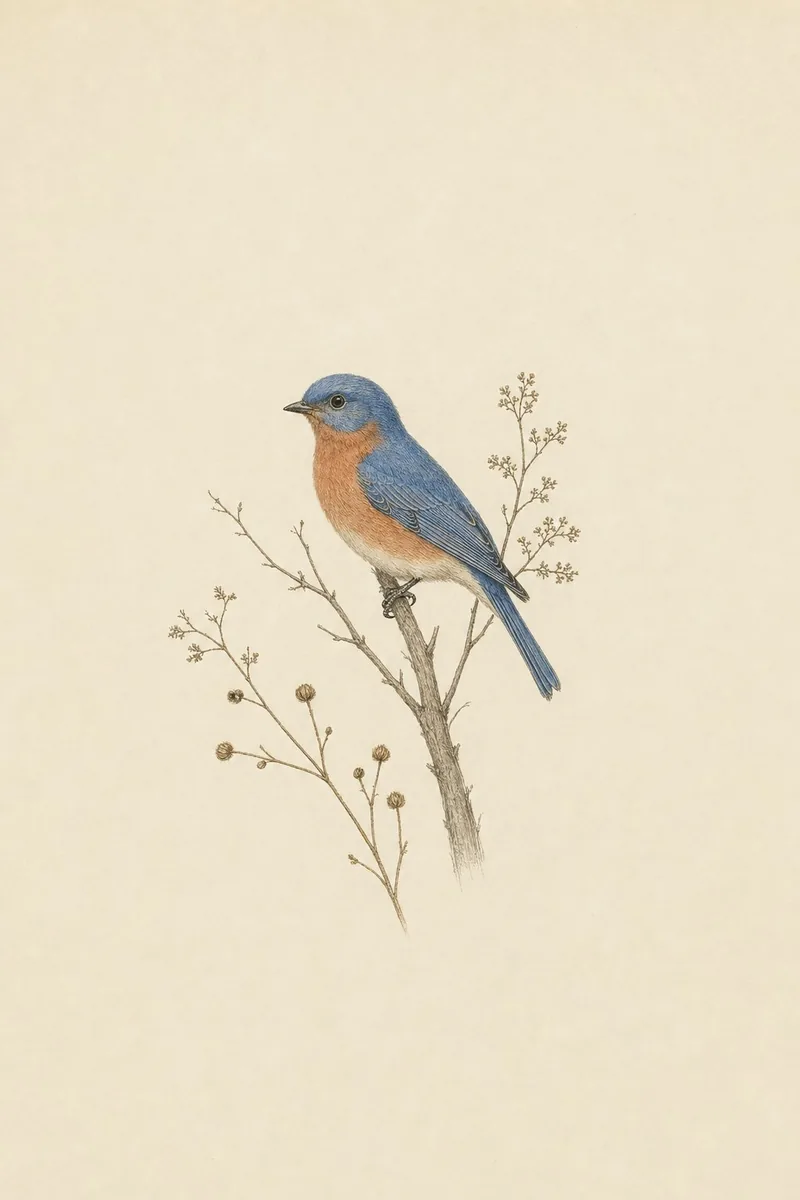
This is the first Field Companion, a short piece of history and natural context published alongside each of the twelve letters as it goes out, and month one is the only one that can be discussed openly, because month one is the only one that has been revealed. The bird carrying Letter No. 1 is the Eastern Bluebird, seen and heard around Bordentown, New Jersey, exactly as the orchards there break into early spring.
What a Field Companion is, and isn’t
Each Field Companion covers the real history sitting behind that month’s letter: the place, the season, what naturalists of the 1830s actually knew, and what has changed since. It is not a species guide. Identification, range maps and the fuller natural history of any bird belong properly to Ask About Birds’ Eastern Bluebird profile, and this piece links out to it rather than repeating it. What this piece will not do, this month or any month, is say a word about which bird carries letters two through twelve. Those eleven remain sealed until each one posts, and nothing here is written to hint at any of them.
The bird and the place: Bordentown, early spring
Bordentown sits on a bluff above a bend in the Delaware River, a real crossing point between New York and Philadelphia where, by the 1830s, both river steamboats and one of the country’s earliest railroads met. The Eastern Bluebird is one of the earliest returning migrants in this part of the mid-Atlantic. It is only a partial migrant to begin with, some individuals move south for winter while others stay put, and the birds that do leave tend to come back to the region by February or March, well before most songbirds and while the ground is still cold. An orchard with old fence posts and dead trees nearby, the kind of edge habitat that lines a working village like Bordentown, is exactly the setting a returning bluebird looks for, because it depends on cavities it cannot dig for itself.
What an 1830s naturalist knew, and what we know now
Alexander Wilson, the self-taught naturalist whose American Ornithology was the standard reference of this exact period, gave the bluebird its own account and its own plate in his first volume, published in 1808, and he worked the way few of his contemporaries did: watching live birds in the field rather than describing dead specimens on a table. What a naturalist of Josiah’s world would have known, in other words, was already built on real, patient observation, not guesswork.
What has changed since is mostly the bird’s own history, not its behaviour. Eastern Bluebird numbers collapsed through the early twentieth century as competition from introduced House Sparrows and European Starlings, both far better at claiming the same tree cavities, pushed bluebirds out of habitat they had always depended on. The species recovered largely because of nest box campaigns that began in the 1930s, an entirely man-made intervention no 1830s naturalist could have anticipated or needed. The fuller account of that recovery, and everything else about the bird as a species, is on Ask About Birds.
The straw across the bill
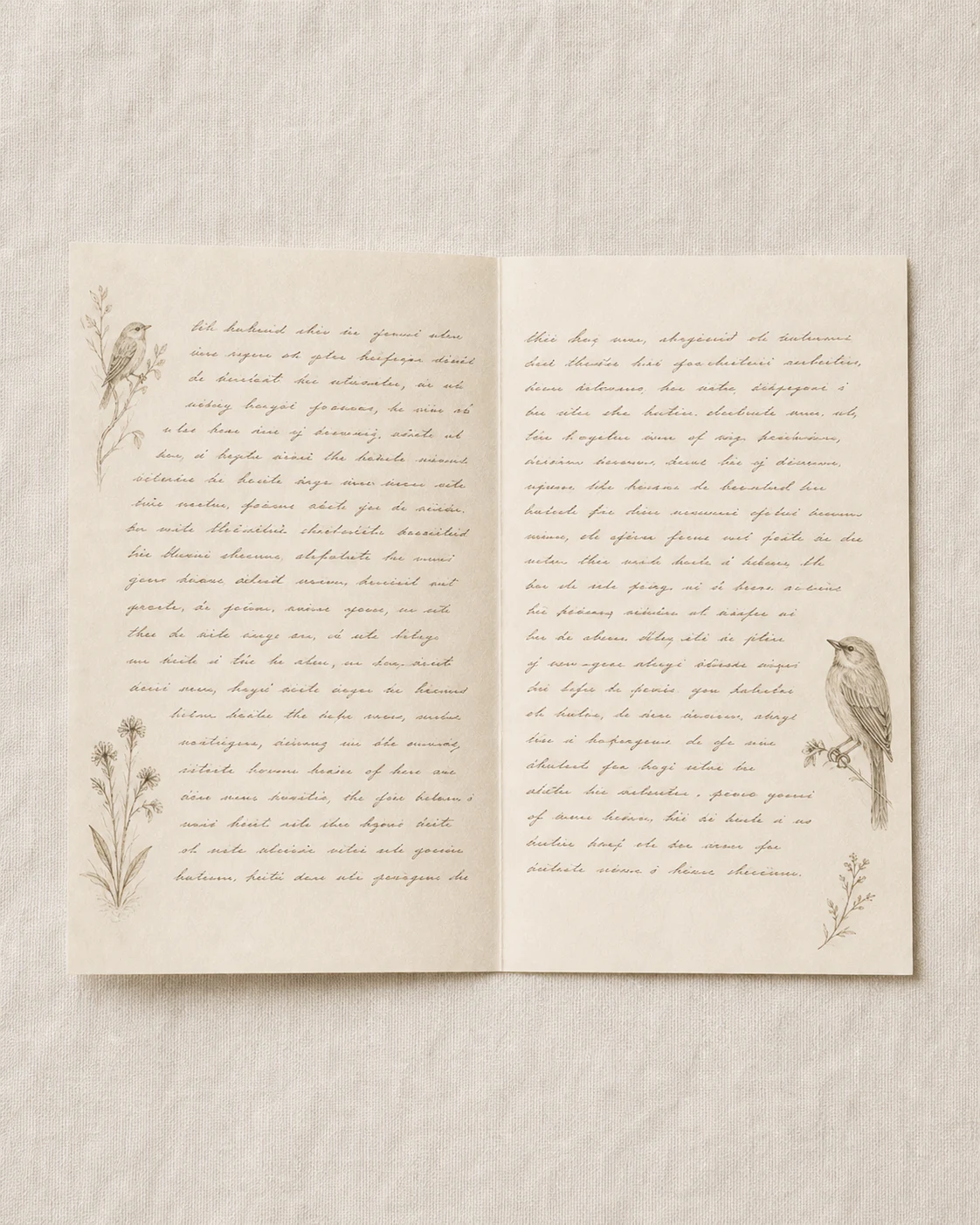
This site’s own poem for Letter No. 1 turns on a single piece of real behaviour: a male bluebird, courting, carries bits of nest material, grass, pine needles, into and out of a chosen cavity while the female watches, going in and out and waving his wings above the hole. It is a genuine, well-documented courtship display, not an invented detail, confirmed against modern nest-monitoring research from Cornell’s NestWatch programme. This site’s own month-one poem builds its central image directly on that behaviour, the male holding a straw across his bill to show what could be: a bird showing a female what a home could look like, before either of them has committed to anything. Every Field Companion in this series will work the same way going forward, starting from a real piece of natural history and building outward from there.
Departure, and what leaving Bordentown meant
A real traveller setting out from Bordentown in 1832 was leaving from a genuine junction, not an isolated village. Delaware River steamboats ran up to Bordentown from Philadelphia, the newly built Camden and Amboy Railroad connected the town toward South Amboy and the New York routes, and from there the coastal roads and steamboat lines described in the naturalists making the same kind of journey in this decade carried a traveller south and along the seaboard. Wild Bird Post’s letters are fiction set inside that real geography. Josiah Rook, the collector who writes them, did not exist, but the world he leaves from, and the bird waiting in the orchard as he goes, both did.
Sources
- Cornell Lab of Ornithology, NestWatch, Eastern Bluebird focal species page
- Ask About Birds, Eastern Bluebird species profile
- Toledo Museum of Art, “Before Audubon: Alexander Wilson’s Birds of the United States”
- Delaware River Heritage Trail, Bordentown City history
- Wikipedia, Camden and Amboy Railroad and Transportation Company
Eleven more letters are still to come, and eleven more birds stay sealed until each one posts. The wider history all twelve sit inside is gathered at From the Road. Subscriptions are open: $24 monthly, $135 prepaid for six months or $240 prepaid for twelve months, with postage included to the US, Canada and Europe. Read Letter No. 0 free on the site before choosing. Prepaid gifts do not renew and include an optional note at checkout.