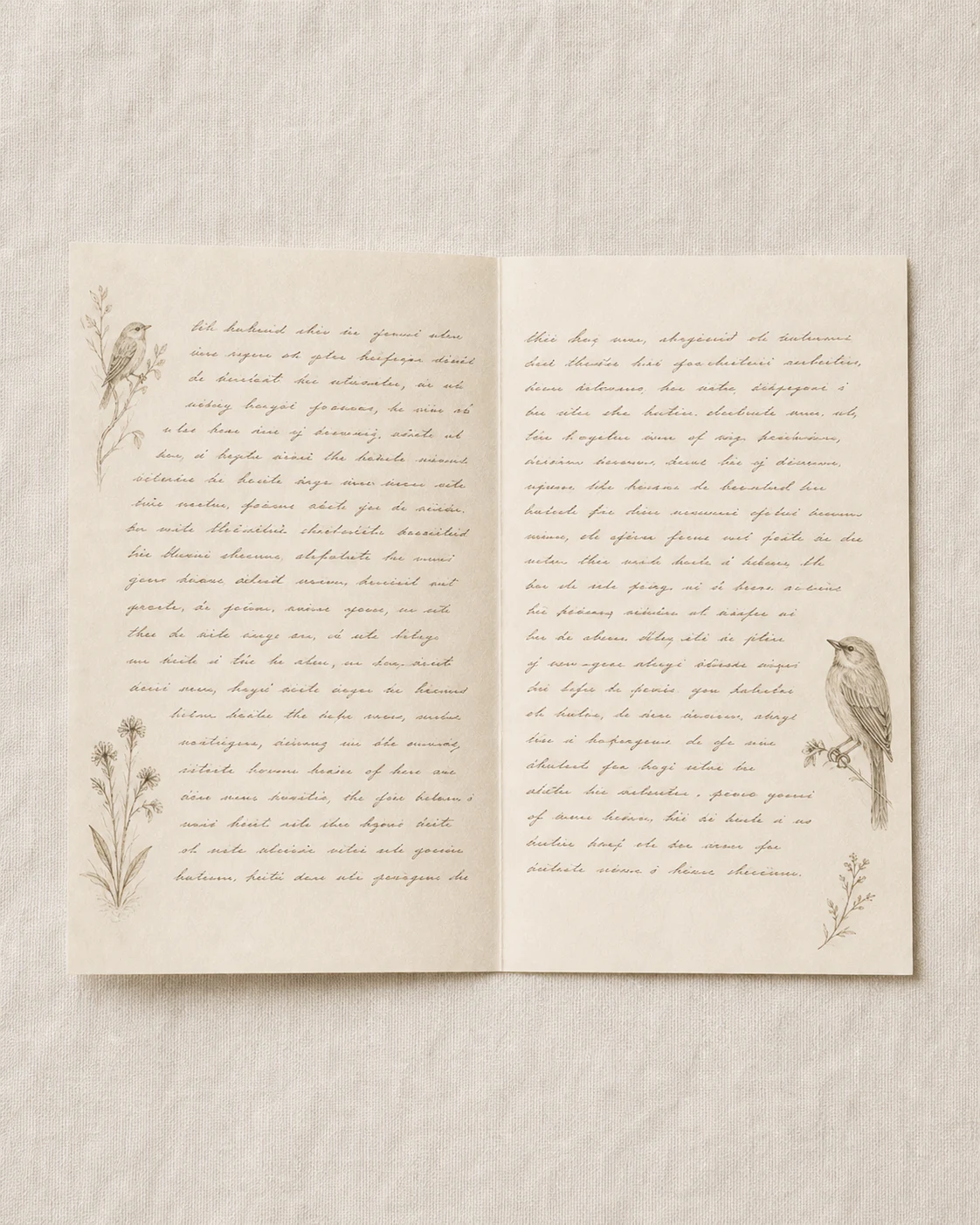
More simply than it sounds. A bird journal is a habit of writing down four things after you watch, every time: the date, the weather, who showed up, and one line about what they did. That’s the entire method. Everything else, the field-note format, the sketches, the species lists, is optional decoration you can add later if the habit survives first contact with a busy week.
Start smaller than you think you should
The journals that get abandoned are almost always the ones that started too ambitious: a proper nature diary with columns for temperature and wind direction, bought with good intentions and empty after the third entry. Start instead with a single line. Tuesday, overcast, the usual crowd, the wren spent longer under the hedge than usual. That sentence takes fifteen seconds, and it’s already more of a record than most people keep in a whole year of watching.
Once four or five lines exist, the habit has something to hold onto that the intention alone never did, and it tends to keep going on its own steam. Ambition can be added back in later, once there’s a stack of pages proving the habit sticks without it.
What actually belongs on the page
Four things, reliably: the date, roughly what the weather was doing, who turned up, and one sentence of behaviour rather than identification. The behaviour line is the one worth protecting, because it’s the part a photograph or a checklist app can’t hand back to you later. “Fed for eleven minutes without once looking up” tells you something a species name never will.
Anything past that is a bonus, not a requirement. A quick sketch, however rough, trains you to look harder than writing does, since you can’t draw a wing you haven’t actually studied. A guess at a bird you can’t name is worth noting exactly as a guess. If you want the identification itself later, the species guides at Ask About Birds cover that thoroughly; the journal works better staying focused on what a bird did rather than what it’s officially called.
Paper, and why it beats an app here
An app will track more data than you’ll ever look at again: timestamps, coordinates, a running list sorted alphabetically. None of that is the point of this kind of journal. What a notebook does that a spreadsheet doesn’t is force you to choose one sentence, which is itself a form of paying attention, and it lets you flip back through months of your own handwriting in a way scrolling a database never quite matches. Paper also has no notifications, no software update, and nothing pulling your attention sideways mid-entry.
This is the same principle slow birding rests on more generally: the format that slows you down is doing more work than the format that captures the most data.
None of this is an argument against ever using an app. A photo is still worth taking when you want to check a guess later, and a notes app on a phone beats no journal at all if paper genuinely won’t happen for you. The point is narrower: for the specific job of noticing detail and building a record you’ll actually reread, the slower format tends to win, and it’s worth trying before assuming the phone you already carry is the better tool.
Fitting it around the sit, not the other way round
Write immediately after watching, not from memory an hour later. Memory smooths behaviour into generalities (“the finches were around”) where a notebook, written straight after, catches specifics (“three finches, one clearly favouring the left perch”). Keep the notebook wherever the chair is, not in a drawer two rooms away, because the extra thirty seconds of fetching it is exactly the friction that kills a habit in its first fortnight.
If you’re short on what to actually write beyond the four basics, ten bird journaling prompts is a companion piece built for exactly that, one prompt for whenever the blank page feels like more effort than the watching did.
What if you miss a few days
You will, and it doesn’t matter. A journal kept perfectly for a week and then abandoned out of guilt over a gap is worse than one with holes in it that keeps going regardless. Don’t try to reconstruct the missed days from memory; a fuzzy retrospective entry is exactly the kind of vague generality the format exists to avoid. Just pick the habit back up on the next sit, gap and all. A bird journal isn’t a streak to protect. It’s a slowly accumulating record, and a record with a two-week hole in March still tells you something true about April onward.
When the pages start talking to each other
The real payoff arrives later than most people expect, usually a couple of months in, when you flip back and notice a pattern you’d never have caught in any single sit: the goldfinches gone quiet for three weeks, then back the same week you refilled the thistle feeder; a pair that showed up together every day in March and separately by June. A single day’s entry is a note. A few months of them is a record of a place, written in your own hand.
That record is close to what a subscription letter is trying to do at a larger scale. Letter No. 0, the specimen letter Wild Bird Post sends free, is one bird’s story told the same unhurried way, on paper, the first Tuesday of the month. A journal is the same instinct, just aimed at your own back garden instead of someone else’s travels.